
From a Melbourne beekeeper
Bee pollen, honestly
What it actually is, what’s in it, the truth about its benefits, and who should take care with it — straight from the beekeeper, about the pollen the bees bring home.
Bee pollen can cause serious allergic reactions in some people, including anaphylaxis. If you’re allergic to pollen, bee stings, or other bee products, don’t take it without talking to your doctor first.
What is bee pollen?
Bee pollen is the pollen bees collect from flowers, pack into little pellets on their back legs, and carry home. It’s the colony’s protein source — what they feed the growing brood, and what a young hive lives on. Every pellet is bound together with a touch of nectar and the bee’s own enzymes, which is why the granules hold their shape rather than blowing away as loose dust.
It isn’t honey and it isn’t beeswax. It’s a third thing the hive produces, and it looks the part: tiny multicoloured granules, each colour a different flower the bees visited. A jar of it is a record of what was blooming — and if you know the local trees, you can almost read it.
How the bees collect it
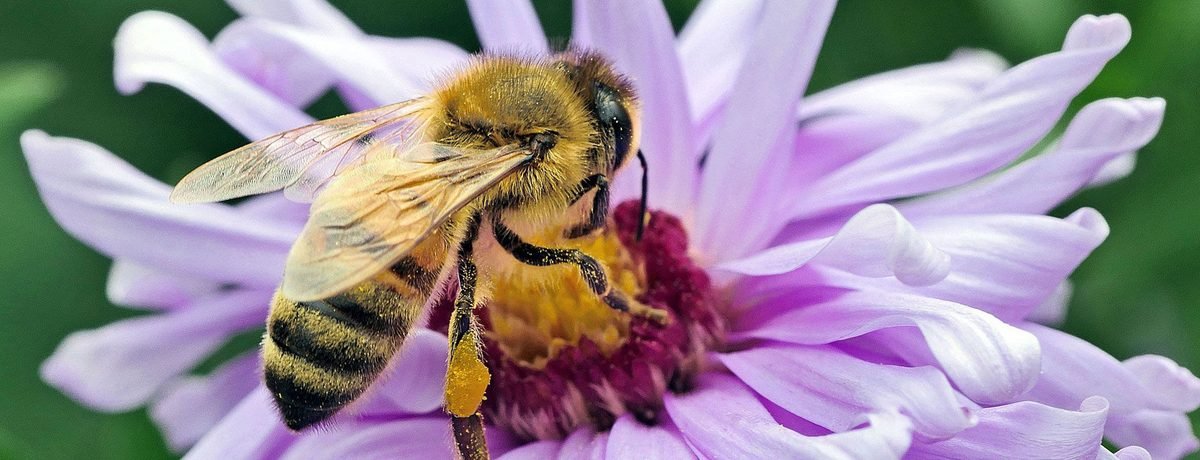
Watching a forager work is the best way to understand pollen. As a bee moves over a flower, pollen catches in the branched hairs that cover her body. She combs it off in flight, moistens it with a little nectar, and packs it into the pollen basket — the corbicula, a smooth, slightly concave patch on the outside of each hind leg, fringed with stiff hairs that hold the load in place. You’ll have seen the result without knowing it: a bee flying home with two fat, brightly coloured bundles, one on each back leg, like tiny saddlebags.
A bee tends to work one kind of flower on any given trip, which is why each pellet is a single, solid colour rather than a muddle — and why a fresh jar is a patchwork of yellows, oranges, ochres, greys and near-blacks. Those colours track the local flora. Across South East Melbourne the palette shifts through the season with the eucalypts and the garden flowers in bloom; you can read more about the trees behind it on our Australian nectar sources page.
What’s in it
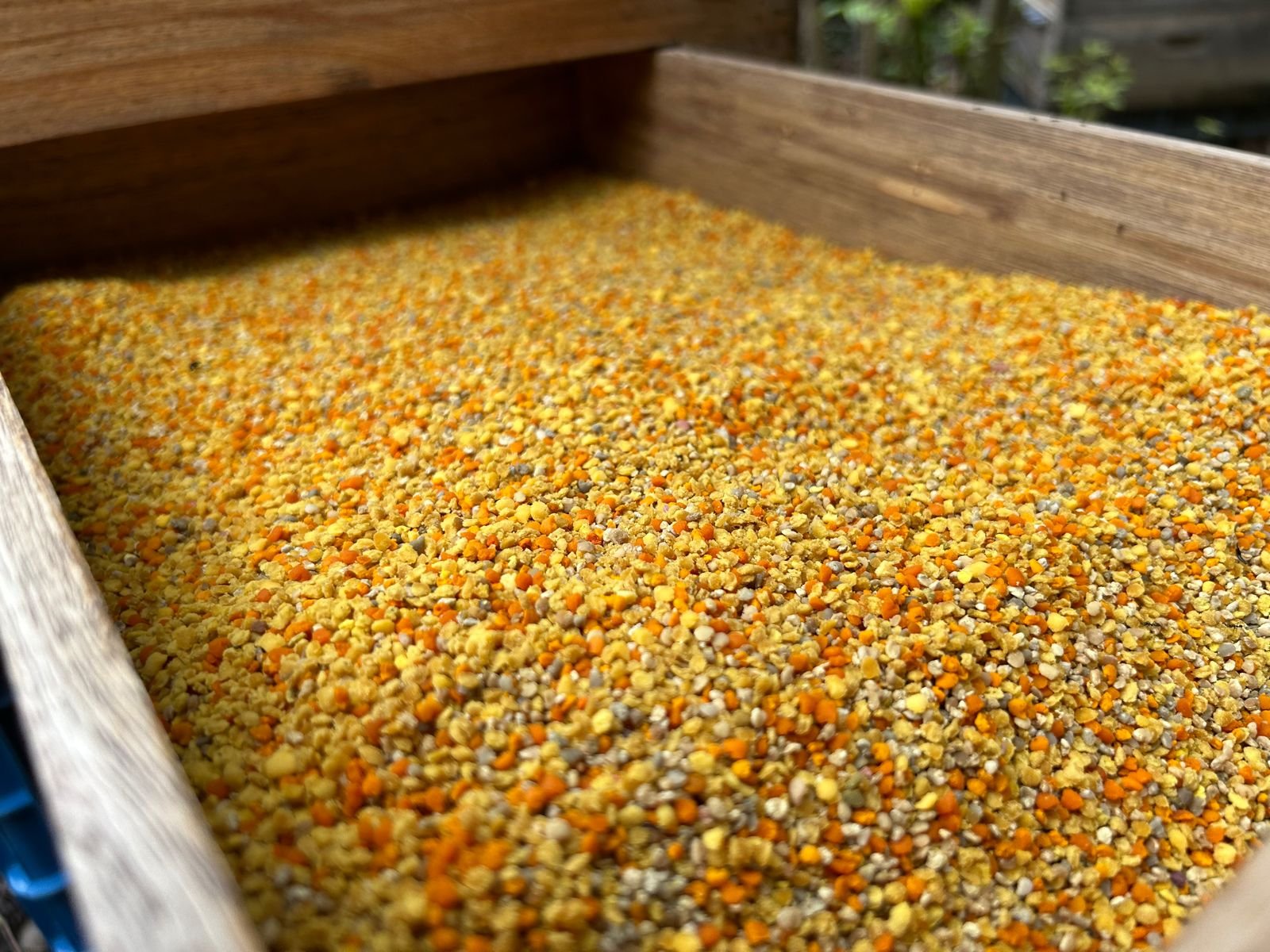
Here’s what pollen physically contains — not what it’ll do for you, just what’s in the granule. Bee pollen is roughly 20–25% protein by weight, which is high for a food, and that protein includes the full range of amino acids. Alongside that it carries carbohydrates, a little fat, and a mix of vitamins and minerals that varies with the flowers it came from. It is, in short, the concentrated protein ration of an insect colony — which is exactly why the bees go to such trouble to gather it.
Because that make-up depends entirely on the flowers, every batch is a little different. Pollen from one part of the season carries the character of that season’s flowers, and ours reflects whatever is flowering across South East Melbourne at the time — foraged fresh, the same way our honey is, each batch its own.
Why raw matters
Pollen is a delicate food. Heat and time both work against it, so how it’s handled after it leaves the hive matters as much as where it came from. A lot of commercial pollen is dried hard and fast at high temperature, because it’s quicker and it makes the granules shelf-stable — but that industrial heat degrades the more fragile components, the same way over-cooking degrades any fresh food.
Ours is handled gently. Our fresh pollen goes straight from hive to cold storage and reaches you as close to how the bees packed it as a food can be. Our dried pollen is dried slowly and gently, at low temperature, purely to make it keep at room temperature. Both stay raw. That’s the whole point of eating it this way: whatever the bees put into the granule stays in it.
What are the benefits of bee pollen?
This is the question everyone arrives with, so here’s an honest answer. Bee pollen is widely marketed as a “superfood,” and you’ll find claims online that it does everything from lifting energy to easing hay fever to boosting immunity. It’s important to be straight about where those claims stand: most of them rest on traditional use and small or preliminary studies, not the kind of robust evidence that would let anyone promise you a result. Some are actively cautioned against — the idea that eating local pollen desensitises hay fever, for instance, is popular but not established, and for a pollen-allergic person it can be dangerous rather than helpful.
So rather than tell you what bee pollen will do for your health — I’m a beekeeper, not a nutritionist or a doctor, and I’d be cautious of anyone selling it who claims to be — I’ll tell you honestly what it is: a raw, whole food, high in protein, carrying the vitamins and minerals of the flowers it came from, made by the bees and left exactly as they made it. Whether that has a place in your diet is your call — and if you have any health condition, that call is one to make with your doctor, not a website.
Who should take care with it
This matters more than any benefit, so it goes in plain:
- Anyone with pollen, bee-sting or bee-product allergies. Reactions can be serious, up to anaphylaxis. Don’t start without medical advice.
- If you’re pregnant or breastfeeding, talk to your doctor first.
- If you take medication or have a health condition, check with your doctor before adding it.
- Not for infants under 12 months, the same as honey.
If you’ve never had it, the sensible first step is a very small amount — a few granules — to see how you react before eating more.
How people eat it
Bee pollen is granular, with a texture between soft and crunchy and a taste that’s faintly floral, faintly bitter — it shifts with the flowers, so one batch is never quite the last. Most people don’t eat it by the spoon; they fold it into something.
- Stirred through yoghurt or sprinkled over it.
- Blended into a smoothie.
- Scattered on porridge, muesli or fruit.
- On toast with our honey, if you want the two hive foods together.
Add it after cooking rather than before — keeping it off the heat is what preserves the reason for eating it raw. Keep it sealed, cool and dry, away from light. Fresh pollen holds moisture, so keep it refrigerated, or frozen for longer storage; dried keeps at room temperature in a sealed jar.
For what it’s worth: I eat it myself, most days, a spoonful through yoghurt. It’s part of my own kitchen, not just something on the shelf.
Ours
We collect pollen with a small trap at the hive entrance that brushes a share of the pellets from the returning foragers’ legs as they pass — and only in spring, when pollen is coming into the hive in abundance and the colony can spare it. The bees keep the lion’s share; we take a little, and never at the colony’s expense. So it’s seasonal: available in spring, sold until it runs out. That’s how a real harvest works — when it’s gone, it’s gone until next season.
It comes from the same rescued, chemical-free, stationary hives as everything else we sell, kept across South East Melbourne at least five kilometres from broadacre crops. The full hive-to-jar standard is on our raw honey standard.
When it’s in season you’ll find it as fresh or dried pollen in the shop. In the meantime, our raw honey and honeycomb are here year-round. Every purchase funds the next rescue.