
Honey & the Hive · Nectar Sources
Australian nectar sources
Honeybees gather nectar from flowering plants and turn it into honey — and in Australia, most of that nectar comes from eucalypts. This guide to the major honey-producing eucalypts of our region was originally written by Dietmar Klimkeit of Amazing Bees, drawing on Frederick Beuhne’s Honey Flora of Victoria (1922), and is preserved and maintained here by BeesFriend. Every one of these trees grows and flowers across our foraging range in South East Melbourne, and between them they account for the character of the honey in the jar.
Why eucalypts, and why identification is hard
There are roughly 900 species of eucalyptus, the vast majority native to Australia, and telling them apart challenges even botanists. The same tree is often known by different common names in different districts, the English names overlap, and the Latin names have shifted over the decades as species were split, merged and reclassified. What follows are the major honey eucalypts of our area — each with the botanical detail to recognise it, and what a beekeeper can expect from it in nectar, pollen and honey.
The classic reference remains Beuhne’s Honey Flora of Victoria (1922), still readable online a century on — much of what follows carries his observations forward.
Grey Box — Eucalyptus microcarpa
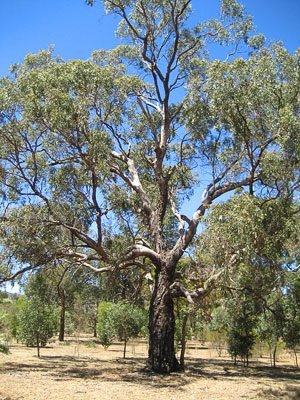
Grey Box is one of the most important and dependable eucalypts for beekeepers in Victoria — very regular in its flowering, producing more or less nectar and pollen every single year, which is rare among eucalypts. A slow-growing, spreading tree of medium size, usually to about 25 metres though some reach 40, with fibrous light-to-dark-grey bark on the trunk and lower branches giving way to smooth grey-brown bark above. Its leaves are broad and lance-shaped, thick and rigid, greyish-green on both sides.
Flowering: February to May, sometimes into June. Individual trees tend to blossom every second year, but there are always some trees flowering every year. Pollen: Grey Box yields great quantities of pollen — often the only source available at the very end of the honey season, which makes it valuable for carrying colonies toward winter. Honey: medium to dark amber, medium density, with an excellent aromatic sweetness. It crystallises after several months.
Yellow Box — Eucalyptus melliodora
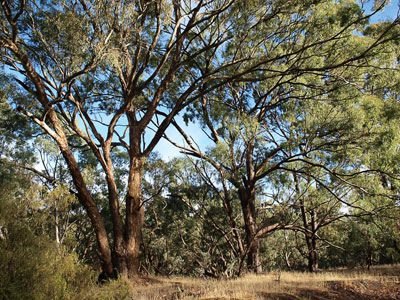
The species name melliodora means “honey-scented,” and Yellow Box is considered one of the most valuable nectar trees in Victoria. A medium tree that can reach sixty metres and a stem over two metres thick at the base, with enormous variation between individuals — some carry rough brownish-grey bark over the whole trunk, others are smooth but for a metre or two near the ground. The leaves are narrow and dull-green; young trees seen from a distance often carry a bluish tinge.
Flowering: generally every second year, roughly November to February, though it varies by location and season. Buds become visible ten to twelve months ahead. Pollen: here is the catch — bees do not collect pollen from Yellow Box. Where no other pollen source is flowering during a Yellow Box flow, the colony’s brood-rearing slows and the worker force dwindles; a companion pollen source such as River Red Gum is needed for the bees to thrive. Honey: perhaps the best-known of all Victorian honeys — pale straw, very dense, aromatic, with a pronounced flavour. Pure Yellow Box is slow to crystallise, though it often carries a little Red Gum honey, which sets it faster.
Red Box — Eucalyptus polyanthemos
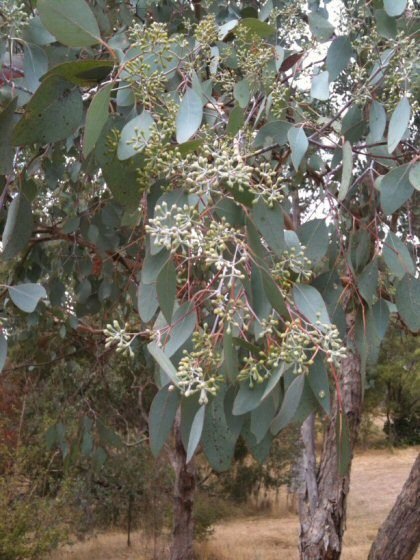
A reliable honey tree noted for its drought tolerance, Red Box — sometimes called Peppermint or Peppermint Box locally — is a medium tree of 7 to 25 metres with distinctive grey-green foliage and a trunk that is often not very straight. Its fibrous dark-grey bark runs right up to the small branches, and its timber is hard and red. The leaves are broad, oval to egg-shaped, on long stalks.
Flowering: September to November, varying by year and place; some trees flower annually, more in every second year. Pollen: the blossom gives excellent nectar but little pollen, so — as with Yellow Box — a companion pollen source is needed through the flow. Honey: very pale with a slightly greenish cast, very dense and aromatic. It can carry a faintly oily note that disappears after about twelve months’ storage, and when pure it is slow to crystallise.
River Red Gum — Eucalyptus camaldulensis
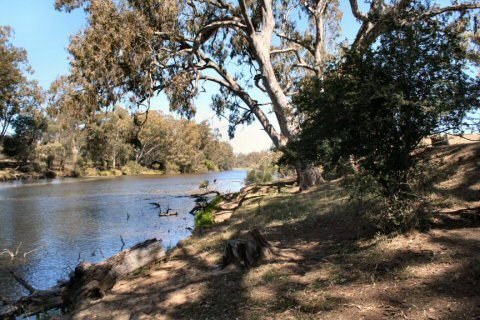
The most widespread eucalypt in Australia, and one of the most valuable — River Red Gum lines watercourses and flood plains across most of the mainland, unmistakable in appearance. It often exceeds 35 metres, up to 60 in the best conditions, with a stout trunk to 4.5 metres across, smooth ash-grey to whitish bark, and dark reddish-brown, very durable wood. Its leaves are slightly sickle-shaped, the same colour on both sides.
Flowering: every second year, usually the same year as Yellow Box and alongside it, December to January. The bloom doesn’t last long on any one tree and there’s little variation between trees, so the flow is intense and brief. Pollen: Red Gum produces pollen in great quantity — which is exactly why it is so prized in Yellow Box country: it keeps brood-rearing going through the Yellow Box flow and lets the bees lay down stores for leaner times. Honey: one of the heaviest nectar yielders of all. Clear golden colour, not quite as dense as Yellow Box, less aromatic but milder and very smooth. It crystallises quickly and sets very hard.
Messmate Stringybark — Eucalyptus obliqua
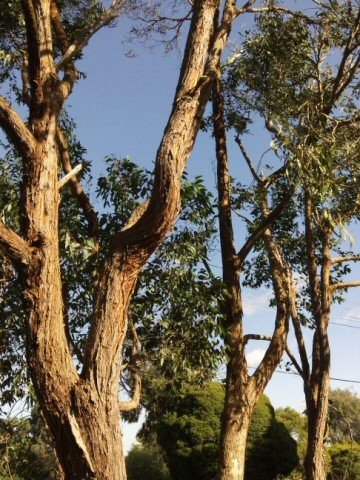
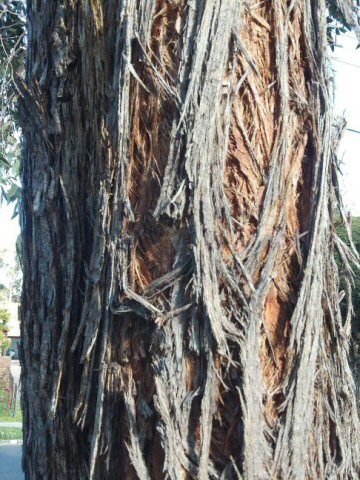
Known by a long list of names — Australian Oak, Brown Top, Messmate, Tasmanian Oak — E. obliqua is a hardwood native to south-eastern Australia and an impressive tree, up to 90 metres with a trunk to three metres across. Its very fibrous, soft bark is light brown within and greyish (or fire-blackened) without; it ignites easily, so Messmate carries bushfire further than most. The leaves are sickle to lance-shaped, glossy and equally green on both sides.
Flowering: usually January to February, abundantly but not every year (it has been recorded flowering in many months). Pollen: because it blooms late in the season, its pollen is useful for building colonies for autumn and laying down winter stores. Honey: one of the darkest, in wet locations recalling molasses — clear, quite dense, with a strong aromatic flavour.
Silver Stringybark — Eucalyptus cephalocarpa
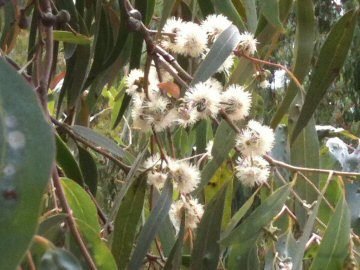
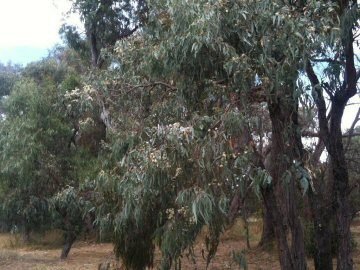
Also called Mealy Stringybark, this is the local tree — common right around Melbourne from the eastern suburbs to the Dandenongs and south to the Mornington Peninsula, then east through Gippsland. A small-to-medium tree to about 15 metres with thick, soft, fissured grey-brown bark of the “peppermint” type, recognisable by its silvery, round, opposite juvenile leaves. It grows on moist sand or poor clay in swamps and damp low slopes.
Flowering: March to August — late. Pollen: as a late bloomer, its pollen (like Messmate’s) helps build colonies for autumn and stock them for winter. Honey: fairly dark, much like Messmate — clear, quite dense, aromatic and strong.
Narrow-leaved Peppermint — Eucalyptus radiata
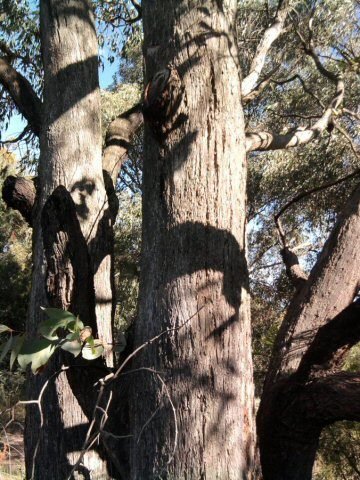
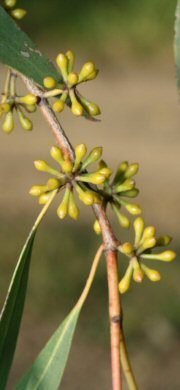
Instantly known by the strong peppermint smell of its bruised leaves, E. radiata is of lesser value to the beekeeper — its nectar and pollen yield is usually not strong. A small-to-medium tree to about 30 metres, with shortly fibrous grey-brown bark shedding in long ribbons, green branchlets, and narrow, sharply pointed, rather thin leaves in dense drooping foliage. It grows on poorer soils in the cooler districts of Victoria, New South Wales and Tasmania.
Flowering: October to December, sometimes into February — practically every year and quite profusely, but without producing much nectar or pollen. Honey: clear, medium to dark amber, quite dense, aromatic and smooth; it crystallises quickly and sets very hard.
Every jar of honey is a map of the season — which trees flowered, in what order, and what the weather allowed the bees to reach.
This is what “raw, local and multifloral” actually means: honey that carries the signature of the trees flowering around our apiaries through the season. See our honey →, read about what unfiltered honey is, or return to everything we know about bees.
Content originally written by Dietmar Klimkeit, Amazing Bees, Melbourne, drawing on F. R. Beuhne’s Honey Flora of Victoria (1922) — preserved and maintained by Laszlo Kun of BeesFriend as a knowledge-sharing legacy in Dietmar’s memory.