
Our Standard
Our raw honey standard — how we keep our bees, hive to jar
Most honey on a shelf tells you nothing about the bees that made it. This page tells you everything about ours: how the bees are kept, how the raw honey is made, and how you can tell real honey from the processed kind. This is our raw honey standard, in full.
Welfare first, chemical-free, and honey taken only when the bees have more than enough. It’s just how I do it, because it’s right.
The bees come first
- Our production hives live on their own honey, and we leave a full box of stores on every hive over winter
- We take only the genuine excess, equalising between hives rather than feeding
- Hives stay put — stationary, kept in place, never trucked interstate or rented out for commercial pollination
- Fully insulated Finnish hives (high-density EPS, roughly R7–R8 — around 6–12× the thermal protection of a standard 22mm timber hive), so bees spend their energy on health, not heating
Genuinely chemical-free honey
- Sites chosen clear of pesticides, insecticides, landfill and agricultural crops within 5km
- Natural timber only, Australian wax foundation, and only what belongs in a hive
- Organic-approved methods throughout, and treatment only in the rare event it’s ever needed
The result is honey with only what the bees put in it — and it’s why our purity story starts at the site, not the jar.
From hive to jar: how our raw honey is made
- Cold-extracted by hand from fully capped frames only, kept raw all the way to the jar
- Strained through a 400-micron sieve to take out wax cappings and comb, then left alone, so the pollen, enzymes and character stay in — true raw, unfiltered honey
- Food-grade stainless steel equipment throughout, cleaned thoroughly before every session — the standard a commercial kitchen works to, so nothing reaches the honey but the honey
- Single-origin — each apiary bottled on its own, so every batch tastes of one place
- Bottled in glass — inert, keeping the honey exactly as it went in
- Sent out in bubble wrap made from corn starch, not plastic — it breaks down naturally instead of lingering for centuries, the same care for the environment we bring to the bees, carried through to your doorstep
The same cappings wax we strain off becomes our beeswax — melted down, filtered at least three times, and poured into hand-dipped candles and blocks.
And some of our honey never goes through the sieve at all — left whole in the comb as honeycomb you can eat, wax and all.
That same care carries right through to how you use it. Keep honey warm rather than hot and it holds everything we worked to keep in — which is the whole idea behind a good honey water.
A second check on ripeness
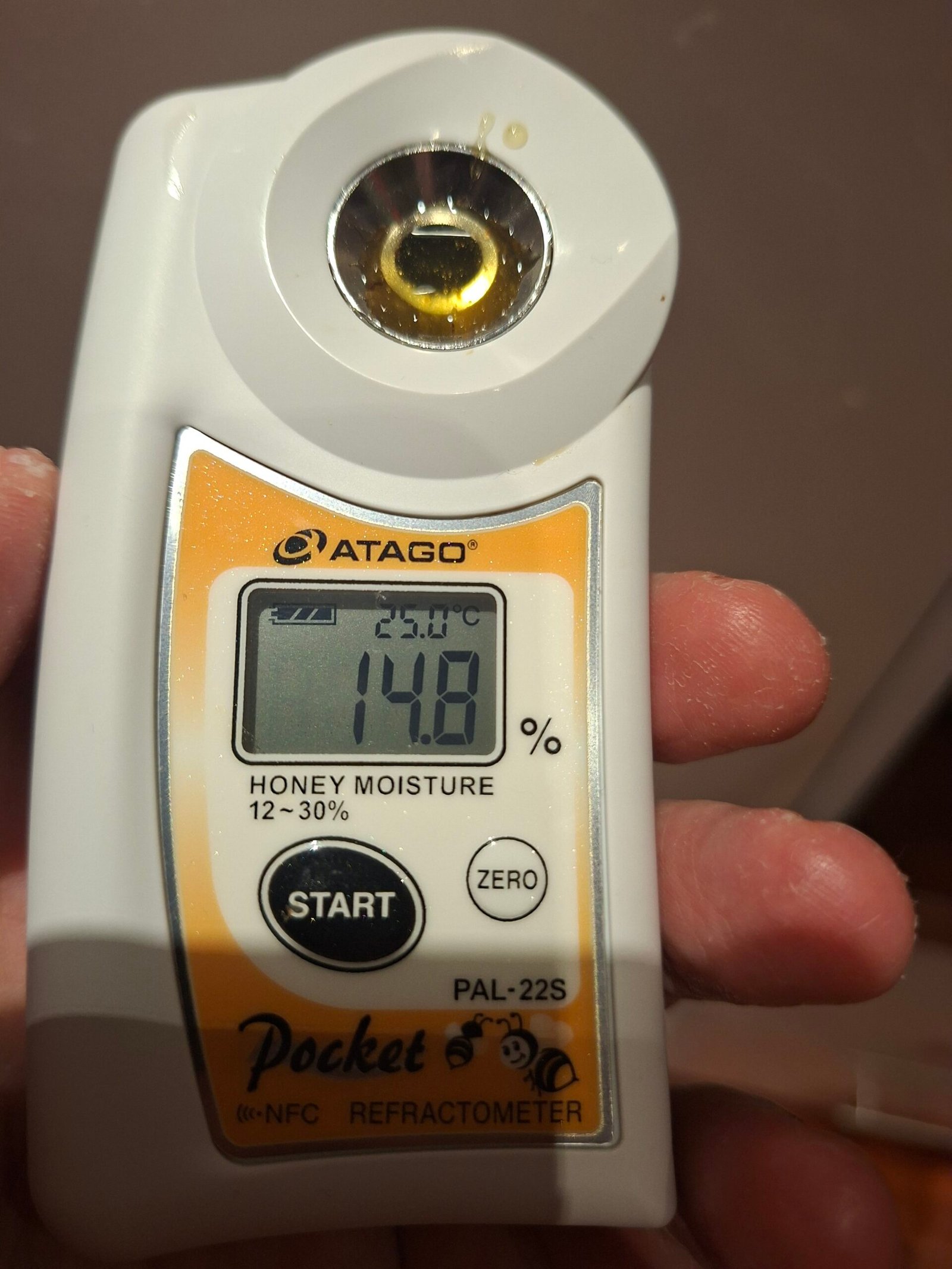
The bees do the real work here. When honey is ripe — the water content low enough to keep — they cap the cell with wax to seal it. That capping is their signal it’s finished, and because we only ever extract from fully capped frames, the honey is already ripe by the time it reaches us.
Checking every batch on a refractometer is simply our second check on top of theirs. It confirms what the capped frames already tell us, and it’s usually just proof the bees did a great job — this batch came in at 14.8% moisture, comfortably below the level where honey can ferment. Low water content like that is one of the clearest marks of properly finished honey: it keeps indefinitely and holds its flavour. One more number we’re happy to stand behind, between the hive and your jar.
Raw honey vs supermarket honey — how to tell real honey
Raw honey behaves differently from the stuff on a supermarket shelf. It sets and crystallises over time. It carries tiny flecks of propolis, the bees’ own resin. It tastes of a place and a season, not of a uniform national blend. Supermarket honey is often heated and fine-filtered until none of that survives — clear, stable, and stripped. Ours keeps all of it, and that’s the whole point of doing it this way.
It’s a fair question why raw honey costs more than a supermarket jar. The answer is everything on this page: you’re paying for the standard the honey is made to — the welfare, the chemical-free sites, the cold extraction, the care in the jar.
All of it comes from bees we rescued across South East Melbourne. If you’re nearby, that’s local honey in the truest sense — made down the road, not trucked in.
Every jar funds the next bee rescue.
Frequently asked questions
Is your honey real, raw honey?
Yes. It’s cold-extracted from fully capped frames and kept raw all the way to the jar, so what the bees put in stays in — the pollen, the natural enzymes, the trace aminos and minerals, and the aromatic compounds that give each batch its character. Most commercial honey is heated and fine-filtered, which drives a lot of that off or strains it out; we keep it. The easiest signs of real raw honey: it crystallises over time (a sign the natural sugars and pollen are intact, not a fault), it can carry tiny flecks of propolis — the bees’ own resin — and each batch tastes slightly different depending on the apiary and the season it was gathered.
How can I test if my honey is real?
The reliable tells are the natural ones: real raw honey granulates over time, varies batch to batch, and carries a slight cloudiness from the pollen still in it. The kitchen “water test” and “thumb test” you’ll read about online are folklore — the honest signs are the ones above.
What is the water content of your honey?
Because we only extract from fully capped frames, the honey is already ripe when it reaches us — the bees cap the cell once the water content is low enough to keep. We check every batch on a refractometer as a second confirmation, and it typically comes in low; one recent batch measured 14.8%. Low water content is one of the clearest signs of properly finished honey, and it’s why our honey keeps and holds its flavour.
Is it organic honey?
We keep our bees to organic-approved methods — organic-approved treatments only, natural timber, and sites clear of pesticides and crops within 5km. We hold to the practice fully; we’d rather tell you exactly what we do than lean on a label.
What does “unfiltered” mean?
It means we strain the honey through a coarse 400-micron sieve to take out wax cappings and comb, and stop there. We keep it unfiltered, so the pollen and enzymes stay in — the step most commercial honey uses to strip them out for a clear jar is the step we skip. Unfiltered honey looks a little cloudy — that’s the good stuff still in it. More on what unfiltered honey is, and how it differs from filtered.
Is honey vegan?
Honey is an animal product, so it sits outside a vegan diet. What we can say is that our bees come first: they’re rescued, kept on their own honey, kept chemical-free, and we only ever take the genuine surplus.
Why is raw honey so expensive?
Because of everything on this page. Keeping bees this way — chemical-free, stationary, insulated, living on their own honey, extracted by hand and kept raw — is a standard that costs more than an industrial line. You’re paying for the standard, and the honey that comes from it.