
Native Bees · Conservation
Australian native bees
Of the nearly 20,000 bee species known worldwide, around 1,700 named species are native to Australia — with many more still waiting to be described — and most people have never knowingly seen one. They range from tiny black stingless bees a few millimetres long to the large, loud carpenter bee, and the overwhelming majority live nothing like the honeybee in a hive. Most are solitary: a single female builds and provisions her own nest, with no colony, no shared store of honey, and no swarm to defend. Only a handful are social. Together they are among the oldest pollinators on the continent, and they were working these flowers for millions of years before the first honeybee ever arrived.
A note on what we keep — and what we don’t
BeesFriend is a honeybee rescue. The bees we save and relocate are European honeybees (Apis mellifera), an introduced species that lives in large colonies and makes the honey we know. Native bees are a different story: mostly solitary, mostly stingless or barely able to sting, and — apart from a few social stingless species kept by enthusiasts in the warmer states — not the honey-in-a-box bee most people picture. We don’t rescue or sell native bees, and you can’t call us out to collect one. We write about them because protecting pollinators means all of them, and because the more people who can recognise a blue-banded bee hovering over the salvia, or a teddy bear bee asleep on a stem at dusk, the more of them survive.
You can’t protect what you can’t see. Most Australians walk past a dozen native bees a week and call them flies.
Native bees and the honeybee — why we keep both in mind
Most of the food we grow — almonds, apples, cherries, pears, canola, berries, melons — arrived with European settlers and doesn’t occur here naturally. European honeybees are those crops’ natural partners, and, just as importantly, they live in colonies of tens of thousands that can be loaded on a truck and moved to a flowering orchard overnight. Native bees, being mostly solitary, can’t be marshalled that way. So honeybees do the heavy lifting of commercial pollination, and they always will.
That doesn’t make native bees lesser — it makes them different, and irreplaceable. Many evolved alongside particular native plants and pollinate them in ways an introduced honeybee never can. The clearest example is buzz pollination: some flowers — tomatoes, eggplants, kiwifruit, blueberries, and many native species — lock their pollen inside tubes that only release it when shaken at the right frequency. A blue-banded bee grips the flower and vibrates its flight muscles to shake the pollen loose. A honeybee simply cannot do it. Two systems of pollination, both needed; one just happens to make the honey.
Stingless bees, and the tiny harvest of sugarbag
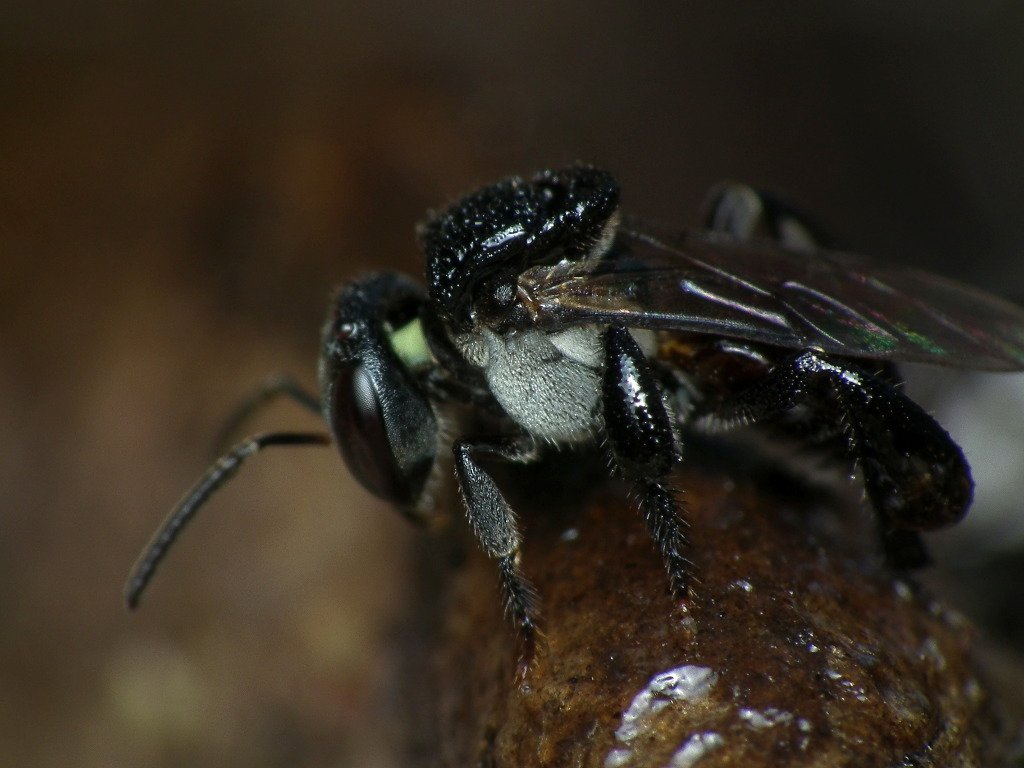
Of Australia’s 1,700-odd native species, only 11 are stingless (older counts put it at 14) — the only truly social native bees, living in colonies of several thousand with a queen, workers and drones, mostly in the warmer north from around Bundaberg down the coast to southern New South Wales. They are tiny: Tetragonula carbonaria, the best known, is a black bee barely four millimetres long, its face and sides dusted with fine white hair. They can’t sting, but they’re far from defenceless — guard bees hold a narrow entrance tube, and the colony will mummify an invading small hive beetle, coating it in wax, resin and mud until it can’t move.
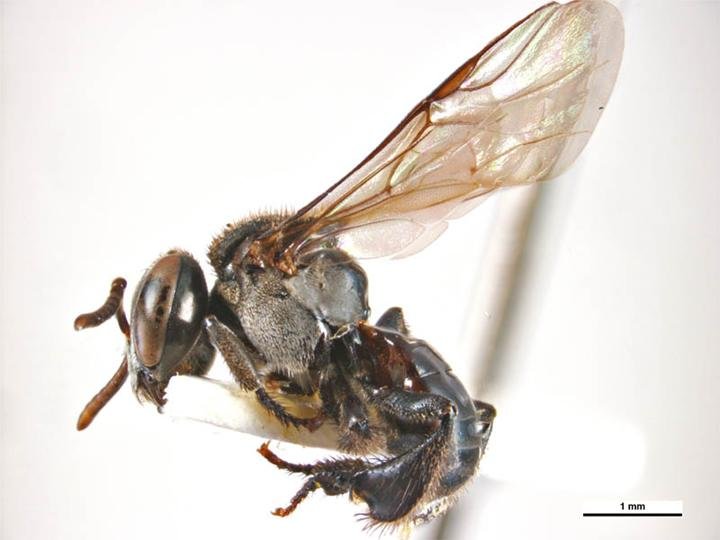
They are the only native bees that make honey in any quantity — and even then only about a kilogram a year from a strong nest: a tangy, bush-flavoured “sugarbag” honey, thinner and more citrus-sharp than anything a European hive produces (which can store 70–100 kg in a good season). Aboriginal peoples have harvested sugarbag for millennia. Today T. carbonaria and its relative T. hockingsi are kept in boxes to pollinate macadamia, avocado and other crops in Queensland and northern New South Wales. This far south in Melbourne it’s generally too cold for them to thrive outdoors — which is exactly why our region’s native-bee story is a solitary one.
Like every wild bee, stingless colonies are under pressure from development — their nests sit in the hollows of old trees, and a tree that comes down takes the colony with it. So in the warmer states there are people doing for stingless bees what we do for honeybees: lifting colonies out of felled logs, water-meter boxes and wall cavities and rehoming them rather than losing them. If you’re in stingless-bee country and find one, Aussie Bee keeps a list of keepers and rescuers by region.
The blue-banded bee
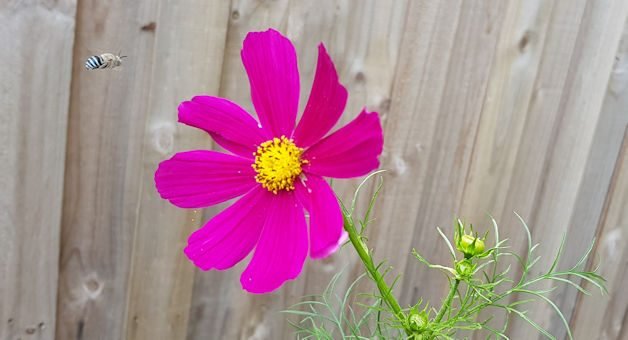
Perhaps the most beautiful of all is the blue-banded bee (Amegilla cingulata) — a solitary native with shimmering iridescent bands, seen hovering in front of a flower before darting to the next. It’s one of our buzz-pollination specialists, and a familiar summer sight over salvia, lavender and abelia in Melbourne gardens — we’ve spotted them a handful of times at our own sites in South East Melbourne. It deserves more than a paragraph.
The teddy bear bee
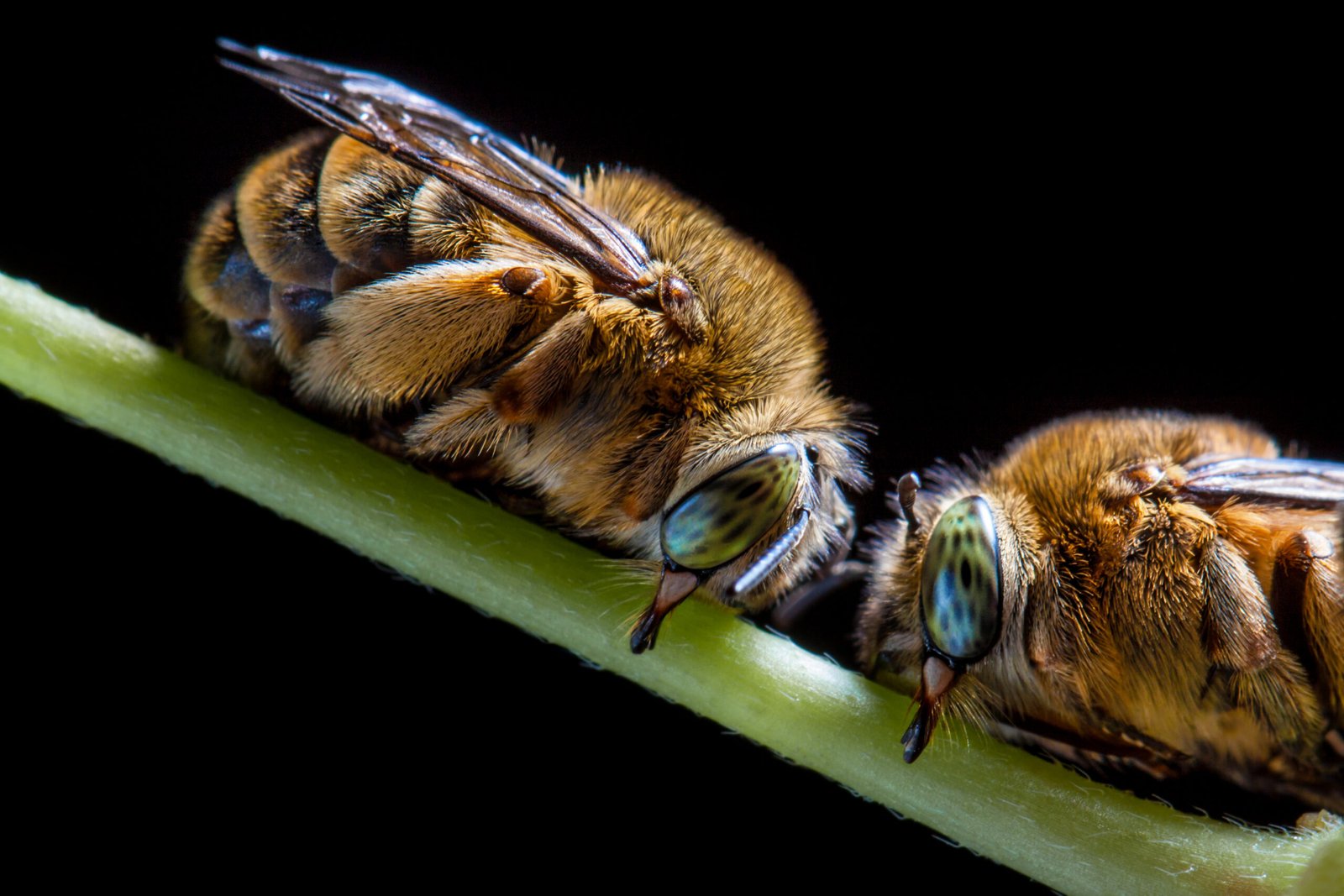
A close cousin of the blue-banded bee, the teddy bear bee (Amegilla bombiformis) is a stocky, bumblebee-shaped native covered in soft orange-brown fur — hence the name. It’s about the size of a honeybee, with dark hairless bands across the abdomen: seven on the males, six on the females. Like the blue-banded bee it’s a solitary buzz-pollinator, recorded working abelia, buddleja and blue flax lily (Dianella) in gardens. Its most endearing habit is at dusk: the males don’t return to a nest but clamp onto a plant stem with their jaws and sleep there overnight, sometimes several to a twig — which is exactly the moment the photograph above was taken.
Leafcutters, resin bees, and the others you’ll meet
Most gardeners meet the leafcutter bees (Megachile) before they ever see one — through the neat, near-perfect circular discs snipped from the edges of rose and other soft leaves. The bee carries each disc away to line the cells of her nest, tucked in a hollow stem or cavity, one leaf-wrapped cell after another. Their close relatives the resin bees do the same job with plant resin instead of leaf, sealing their nests in existing holes in timber and stonework; they come in many sizes and colours, some black with white tufts, some with bright orange abdomens.
Beyond these you’ll find the large carpenter bees, which bore nesting galleries into dead wood; the fast, ground-nesting Amegilla diggers; and the tiny, wasp-like masked bees with their pale-marked faces. Almost all are solitary, almost none will sting you, and once you start looking they turn out to be everywhere — in the garden, the nature strip, the cracks in an old brick wall.
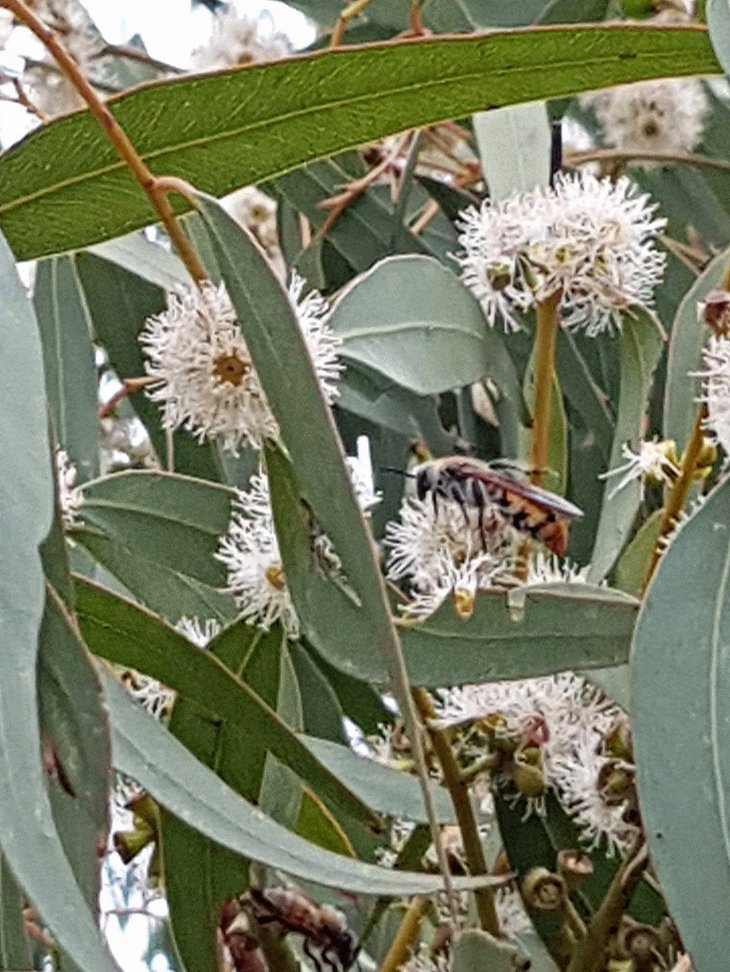
Spotting one is one thing; having a camera ready before it moves on is another. Dietmar managed it one April afternoon in 2019, on the white blossom of a Silver Leaf Stringybark — and even then he couldn’t say for certain what he’d caught.
Why they matter — and what threatens them
Native bees pollinate the plants that evolved alongside them — including, through buzz pollination, natives and crops that honeybees service poorly or not at all. Lose the native bees and you don’t just lose the bees; you lose the pollination of a whole layer of the Australian bush, and the seed and fruit that depend on it.
They’re under pressure from the same forces as everything else wild: habitat loss and land clearing, pesticides — especially the systemic insecticides that turn up in a plant’s own pollen and nectar — and the steady tidying-away of the messy corners that solitary bees nest in: bare ground, dead wood, hollow stems, old mortar. A perfectly manicured garden is, to a native bee, a desert.
Victoria has already lost one. The Metallic Green Carpenter Bee, a glittering native that nests in dead banksia and grass-tree stems, once lived here; as the forests that grew those plants were cleared, it disappeared from the state, and today it survives only north of Sydney and possibly on Kangaroo Island. One threat native bees are spared: the Varroa mite. It parasitises honeybees only, which is why our Varroa surveillance work is about the hives — not the wild bees around them.
How to help
The good news is that helping native bees is genuinely easy, and mostly means doing less. Leave some bare, undisturbed ground for the diggers. Keep a patch of the garden a little wild. Leave a few hollow stems standing over winter, and don’t clear every scrap of dead wood — that’s leafcutter and resin-bee habitat. Plant for a long flowering season, favour blue and purple flowers the Amegilla bees love, and put the sprays away.
With thanks
This page carries forward the work of Dietmar Klimkeit, the beekeeper who mentored BeesFriend’s founder and kept the original Amazing Bees. His own thanks went to Anne Dollin of the Australian Native Bee Research Centre (Aussie Bee), whose lifetime of work documenting Australia’s native species informs any honest page on the subject, including this one.
BeesFriend exists to give bees a voice — the whole story is here. And if it’s a honeybee swarm or colony you’ve found, not a native, that’s what our rescue does.