
From a Melbourne beekeeper
Why do bees swarm?
A swarm looks alarming and is almost always harmless. Here’s what’s actually happening — why a colony splits, what the cluster on your fence is doing, and what to do about it.
The short answer
Bees swarm to reproduce — not the individual bees, but the colony itself. A honeybee colony is really one organism, and swarming is how it divides in two. The old queen leaves with about half the workers to start somewhere new, and the original hive raises a fresh queen to carry on. One colony becomes two.
It’s not a sign of anything wrong. It’s a healthy colony doing exactly what it’s built to do, at the one time of year it can.
What makes a colony swarm
A few things line up in spring and tip the colony into it:
- They’ve run out of room. A strong colony fills the box with brood and honey, and once there’s no space left to lay or store, the instinct to split kicks in.
- Spring is flush. Nectar and pollen pour in, the colony’s population explodes, and there are suddenly enough bees to make two viable colonies out of one.
- The queen’s signal thins out. In a crowded hive her pheromone doesn’t reach every bee, and the colony reads that as the moment to raise new queens and prepare to leave.
Put simply: a healthy hive, a good spring, and not enough space. That’s the recipe, and it’s why swarm season peaks from roughly September to December in Melbourne.
What the cluster on your fence is doing
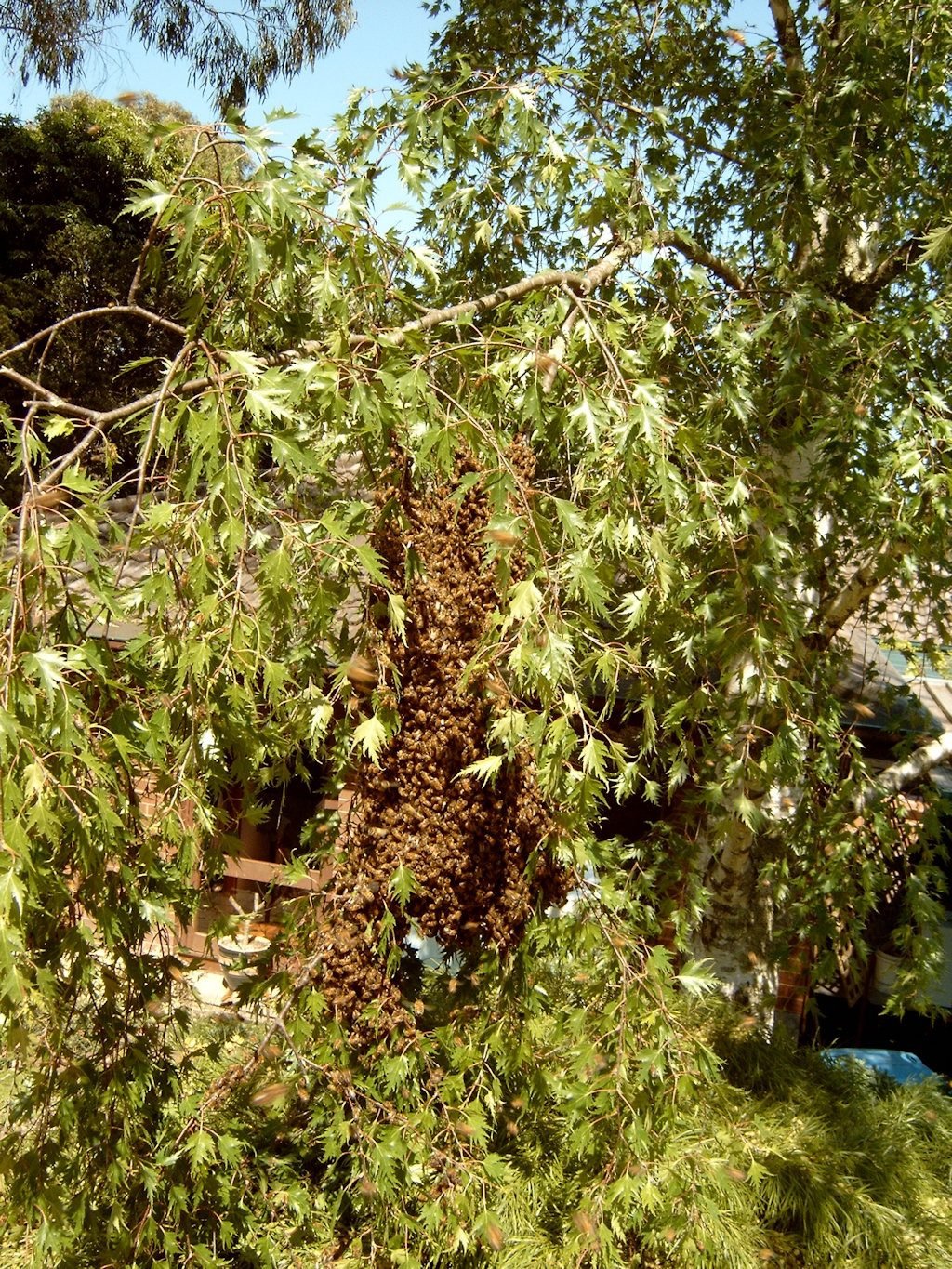
When bees swarm they don’t fly straight to a new home — they don’t have one yet. The whole group settles somewhere in the open first, often a branch, a fence post or a wall, in a hanging clump around the queen. That clump can sit there for a few hours or a couple of days.
While it hangs there, scout bees are out searching for a permanent cavity — a hollow tree, a wall void, a chimney. When they agree on one, the whole swarm lifts off and moves in. The cluster you’re looking at is a colony between homes, waiting on its scouts.
Are swarming bees dangerous?
Almost never. A swarm is about the calmest bees you’ll ever meet. They have no hive, no honey and no brood to defend — and before they leave, they fill up on honey for the journey, which leaves them full and docile. A bee with a belly full of honey isn’t looking for a fight.
That said: don’t spray them, don’t poke the cluster, and don’t try to knock it down. Provoked, any bee can sting, and someone with a bee-sting allergy should keep well clear regardless. Give them room and they’ll almost always move on by themselves — or a beekeeper will collect them first.
What to do if you find a swarm
Leave it be and call a beekeeper. A swarm out in the open is easy to collect and rehome alive — it doesn’t need exterminating, and it shouldn’t be. The sooner it’s called in, the more likely it’s caught before it moves into a wall, where removal gets far harder.
If it’s in Berwick or South East Melbourne, we collect swarms alive and rehome them in our own apiaries — no killing, no spraying. If you’re elsewhere, your local beekeeping club or Agriculture Victoria can point you to someone who will.
Can swarming be prevented?
If you keep bees, largely yes — and it’s one of the core skills of beekeeping. Give the colony room before it needs it, check through spring for the queen cells that signal a swarm is being planned, and split the hive yourself on your terms rather than letting it split on its own. A beekeeper who reads the season well rarely loses a swarm.
Learning to see it coming is exactly the kind of thing that’s hard to get from a book and easy to learn at the hive. If you keep bees or want to, that’s what our mentoring is for.
Every colony we keep began as a swarm or a rescue — bees that got a second chance instead of a can of spray. Why we do it this way. Every jar of honey funds the next rescue.