
From a Melbourne beekeeper
Beeswax candles
Hand-dipped from our own cappings wax — the wax the bees draw to seal their honey. A thick taper is dipped around forty times, by hand, one thin coat at a time. Just beeswax and a cotton wick.
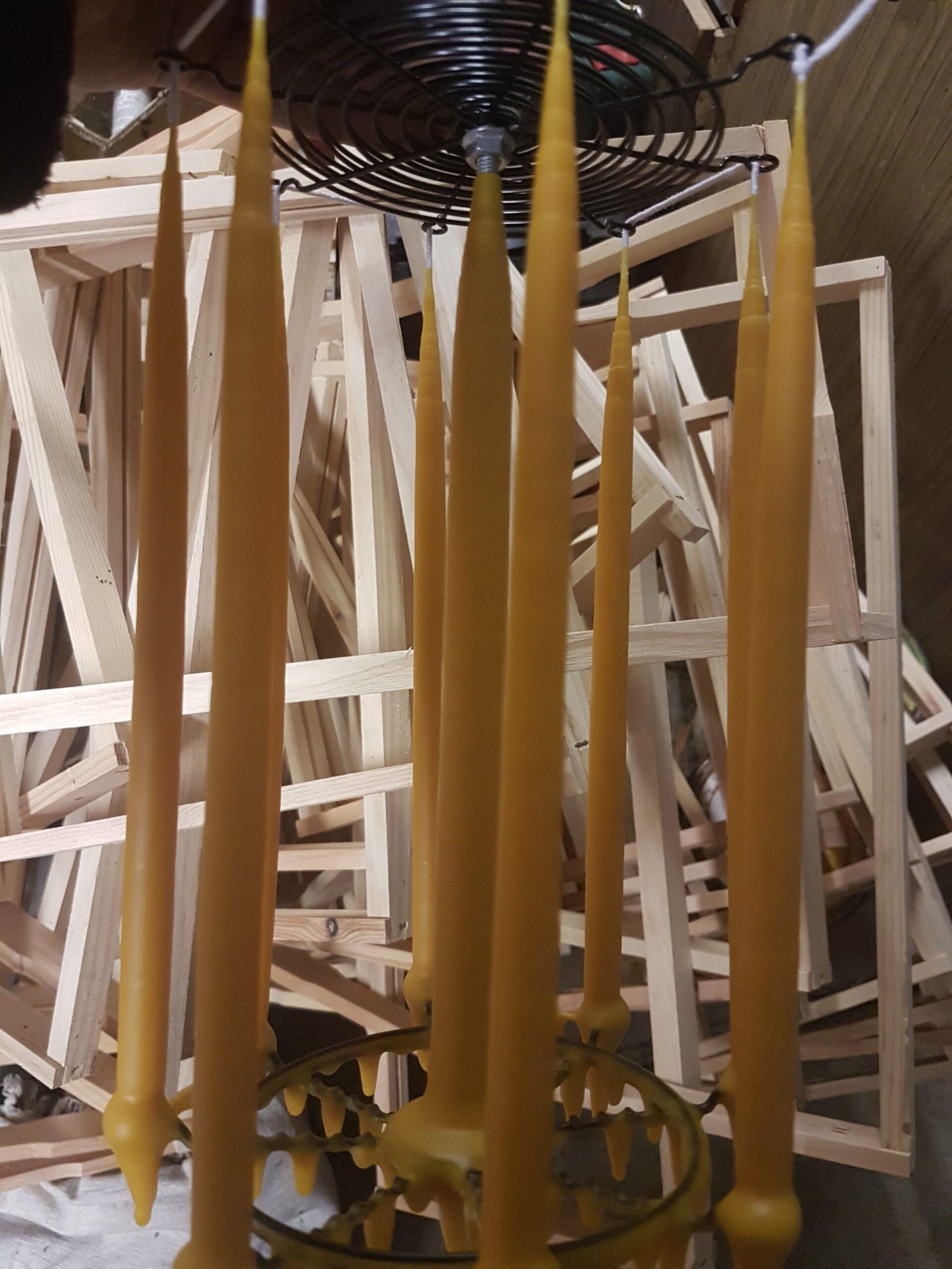
What our beeswax candles are made of
Every candle starts as cappings wax — the fresh wax the bees draw to seal a finished frame of honey, cut from the face of the comb at extraction. It’s the cleanest wax in the hive, and it’s all we use. We melt it gently in a double boiler, never hot enough to scorch, and filter it at least three times. What goes into the candle is pure golden beeswax and a cotton wick. That’s the whole recipe.
The wax is a by-product of our own honey, so every candle traces straight back to the hive. If you want the longer story of the wax itself — what it is and everything else it’s good for — it’s on our beeswax page.
How we dip them
Our tapers are hand-dipped the old way. A length of wick is lowered into the molten wax, lifted out, and left a moment to cool, then dipped again — each pass laying down a hair’s breadth of wax. A thin taper takes around twenty-two dips to build; a thick one around forty-two. There’s no mould and no shortcut. The shape comes from the wax itself, coat by coat, and the pair hangs to set between dips.
Dipping is slower than pouring into a mould, but it’s how a taper gets its dense, even body — the wax laid down in thin layers rather than set in one cast block. A thick taper burns for around 10 hours, a thin one around 4.
The wick, and why cotton
We use a square-braid cotton wick — the type made for beeswax. Beeswax burns at a higher melting point than softer waxes, so it needs a wick with enough draw to keep a steady flame, and the wick has to be sized to the candle: our thin taper (1.1 cm across) takes a 4/0 wick, and the thick one (2.2 cm) a 2/0. Get it right and the flame sits neat and even; too small and it drowns, too big and it smokes.
Square-braid cotton has one more trick: it curls slightly as it burns, so the tip stays in the hottest part of the flame and trims itself, which keeps the burn clean. A plain cotton wick, sized right — nothing more in the candle than that and the wax.
The two kinds we make
Hand-dipped tapers. Built up dip by dip, sold as a pair, in two sizes. The thick is 21 cm tall and 2.2 cm across — a classic dinner-candle profile that burns for around 10 hours. The thin is 22.5 cm tall and 1.1 cm across — a slender taper for a holder or a set table, around 4 hours. Both fit a standard candle holder.
Hand-poured tea lights. A small pour of the same cappings wax with a cotton wick set in the centre, each burning close to 4 hours.
Same wax, same wick, made in small batches by hand. Shop the hand-dipped tapers or the tea lights.
What they’re like to burn
Beeswax burns slow, with a warm golden flame and a faint natural honey scent that comes from the wax itself — there’s no added fragrance, because the wax already smells of the hive. Set one in a draft-free spot and it settles into an even, steady burn, and a beeswax candle generally outlasts a same-size candle in softer waxes.
Over time a real beeswax candle may develop a soft white bloom on the surface — a pale, powdery film. That’s the natural wax rising to the surface, and it’s one of the surest signs the candle is pure beeswax. Leave it for the aged look, or buff it back to gold with a soft cloth or a quick warm from a hairdryer.
How to get the best burn
Burning tip: burn in a draft-free spot for an even burn and a longer life, and trim the wick to about 5–6mm before each light. With tea lights, if a deep pool of melted wax forms around the wick, carefully pour off a little of the excess (onto a heat-safe surface) to keep the wick burning cleanly.
Safety: never leave a burning candle unattended; keep away from children, pets and anything flammable; burn on a heat-resistant surface; take care, melted wax is hot.
Where the wax comes from
Every candle traces back to a colony we rescued rather than killed — out of a wall, a roof, a chimney or a tree, and into a hive. The hives are stationary and chemical-free, at sites across South East Melbourne, and the wax is simply the cappings we strain off at extraction. The full hive-to-jar detail is on our raw honey standard.
Our honey changes with the season and the site — the wax barely does. Cappings wax comes out the same clean gold year on year, so the candle you buy this spring will look and burn like the one you bought last. It’s the steady part of the hive.
Every purchase funds the next bee rescue.
Frequently asked questions
How long do beeswax candles burn?
Our thick hand-dipped tapers (21 cm × 2.2 cm) burn for around 10 hours and the thin ones (22.5 cm × 1.1 cm) around 4; each hand-poured tea light burns close to 4. Burning in a draft-free spot gives you the longest, most even burn.
How are your tapers made?
By hand, by dipping. The wick is lowered into molten cappings wax and lifted to cool, over and over — around 22 dips for a thin taper, around 42 for a thick one — each pass adding a thin layer until the candle is built. No moulds.
Do beeswax candles smell?
They carry a faint natural honey scent that comes from the wax itself. We add no fragrance — the smell is simply the hive, and it’s light rather than strong.
What wick do you use?
A square-braid cotton wick, the type made for beeswax, sized to the candle — a 4/0 in the thin taper and a 2/0 in the thick. Cotton keeps it clean, and the square braid curls as it burns so it trims itself. Nothing in the candle but the wick and the wax.
Why has a white film formed on my beeswax candle?
That’s bloom — the natural wax rising to the surface over time, and one of the surest signs of pure beeswax. Leave it, or buff it back to gold with a soft cloth or a gentle warm.
Do beeswax candles drip?
Burnt in a still, draft-free spot a taper burns cleanly down. A draught is what makes any candle gutter and drip, so keep it away from open windows, fans and doorways for the tidiest burn.