
From a Melbourne beekeeper
American foulbrood
American foulbrood is the disease you don’t gamble with — a notifiable, incurable bacterial disease that kills brood, spreads fast, and leaves spores that last for decades. This is one hive of mine that caught it: how I spotted it, how I confirmed it, and why the only right answer was fire.
What AFB is
American foulbrood — AFB — is a bacterial disease of honey bee brood caused by Paenibacillus larvae. It doesn’t attack adult bees directly; it kills the larvae. A young larva swallows the spores with its food, the bacteria multiply inside it, and it dies after the cell is capped — right when it should be turning into a bee.
The problem is the spores. AFB forms spores that are almost indestructible: they shrug off heat, drying and ordinary disinfectants, and they stay infectious in old comb, honey and equipment for fifty years or more. A single dead larva can hold billions of them. That’s why AFB isn’t something you treat and move on from — there is no cure, and in Australia there’s no legal treatment that works. It’s endemic here, it’s highly contagious, and left alone it spreads hive to hive — through robbing, drifting bees and shared gear — until it takes out an apiary.
How to spot it
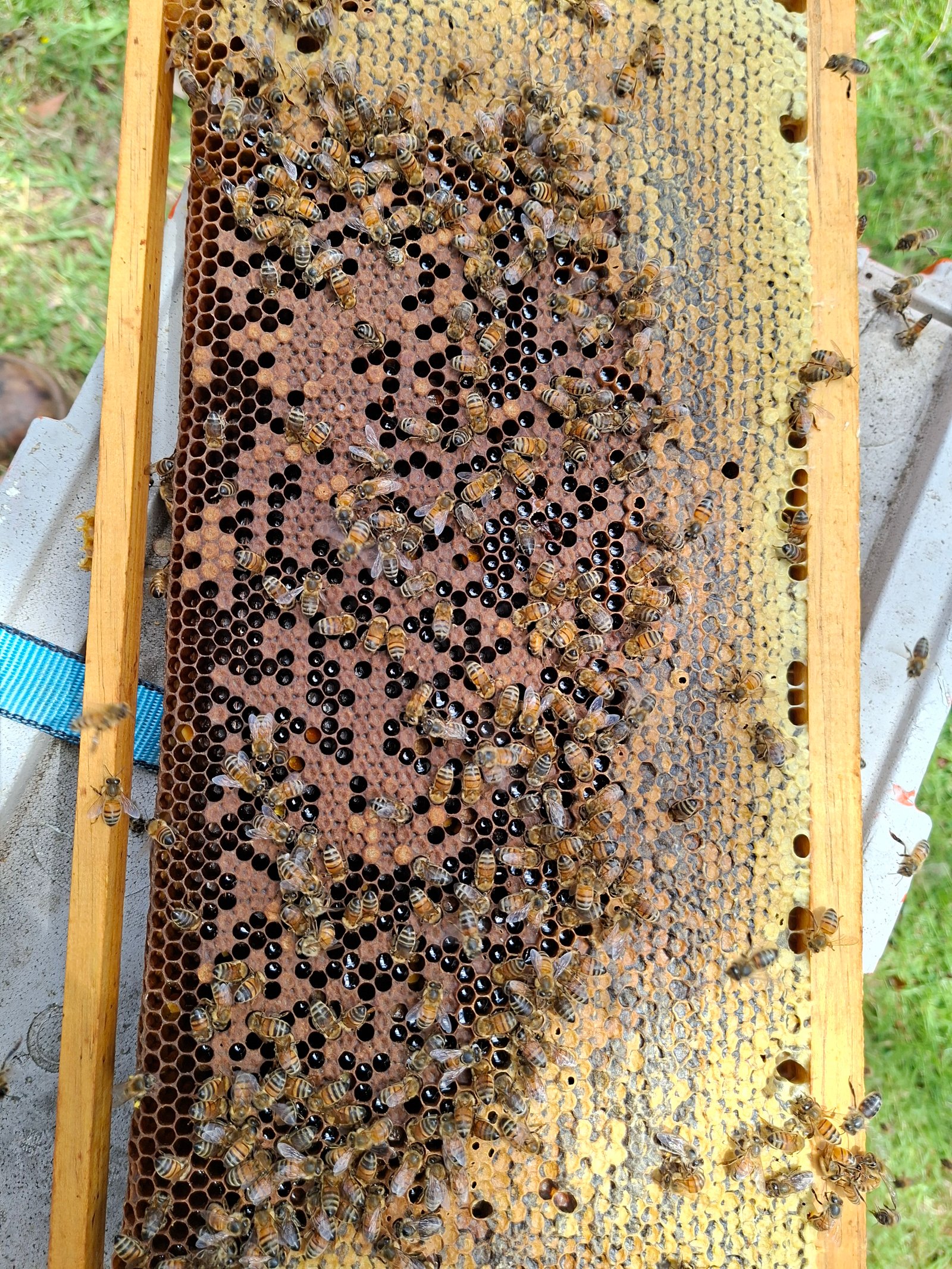
AFB hides in a hive that otherwise looks like it’s working. The tells are in the brood, so you have to actually look at the brood comb — not just the top bars. The signs:
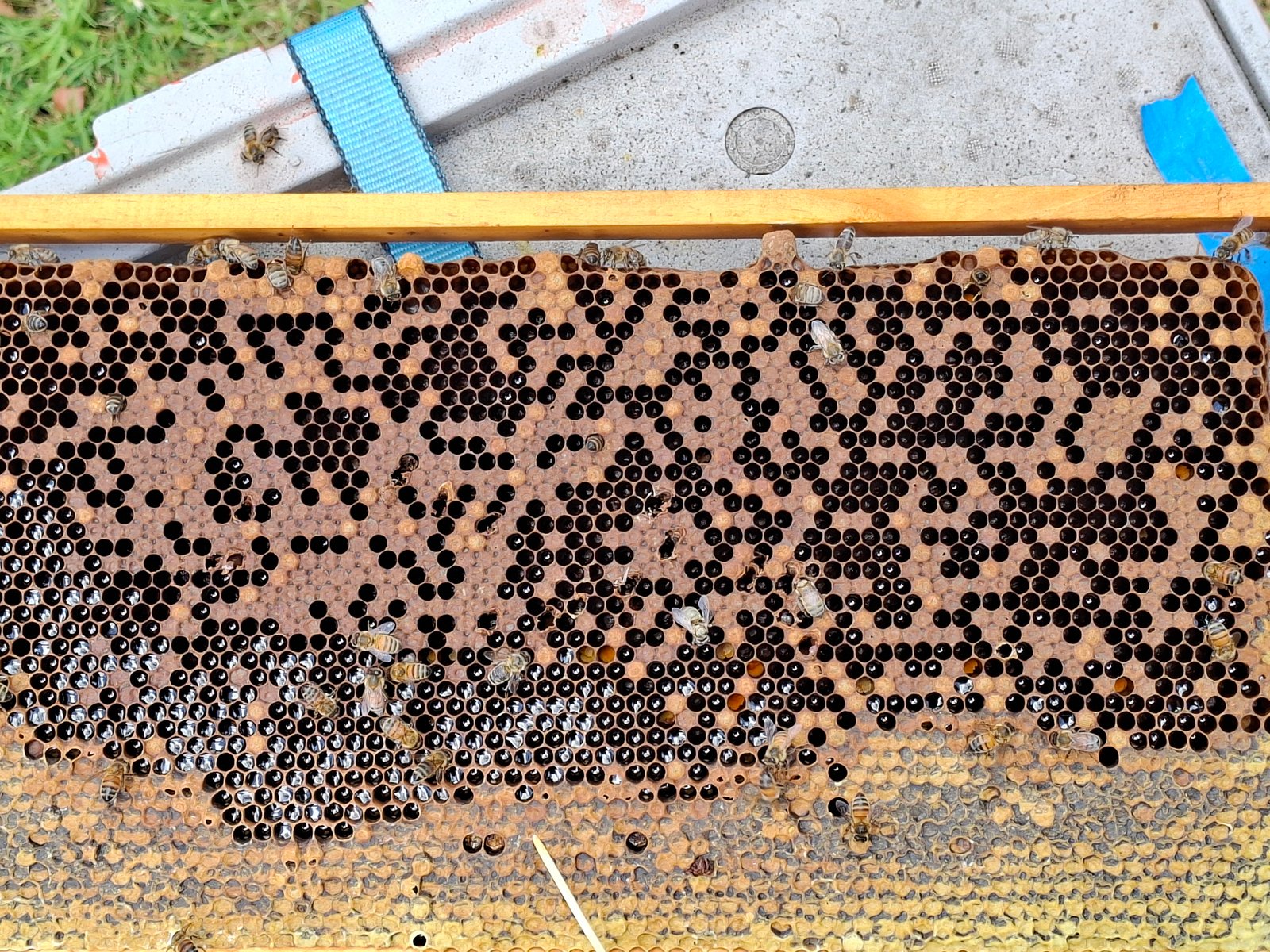
- Patchy brood — a scattered, “pepperpot” pattern with dead and empty cells mixed through the sealed brood, instead of a solid, even slab.
- Sunken cappings — the cappings over dead brood go dark, greasy and sunken instead of dry and domed.
- Perforated cappings — small ragged holes where the bees have started to chew out the dead larva underneath.
- Discoloured remains — the larva turns from pearly white to cream, then coffee-brown, and slumps down the lower wall of the cell.
- A smell — often a foul, glue-pot odour, though you can’t rely on it being there.
On their own, none of these is proof — plenty of things make brood look patchy. But together, on this frame, they were enough to stop me and test.
As it goes on, the dried-out remains harden into a “scale” — a dark, brittle scab stuck hard to the lower side of the cell, so tight the bees can’t clean it out. That scale is packed with spores, and it’s a big part of why infected comb can never be salvaged.
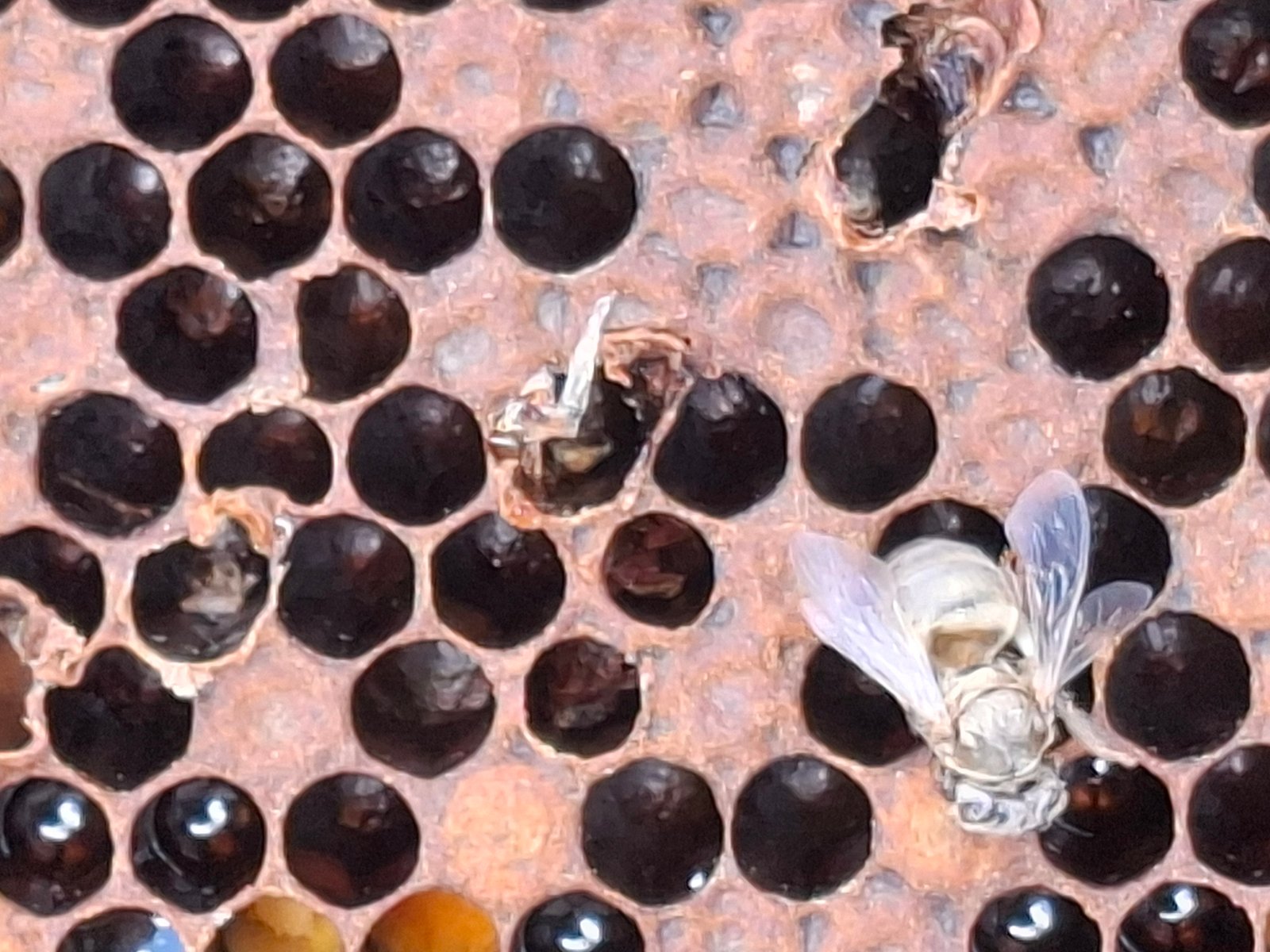
The bees do try — you’ll see cappings chewed open and pupae half-hauled-out — but they can’t win against the spores.
The ropiness test
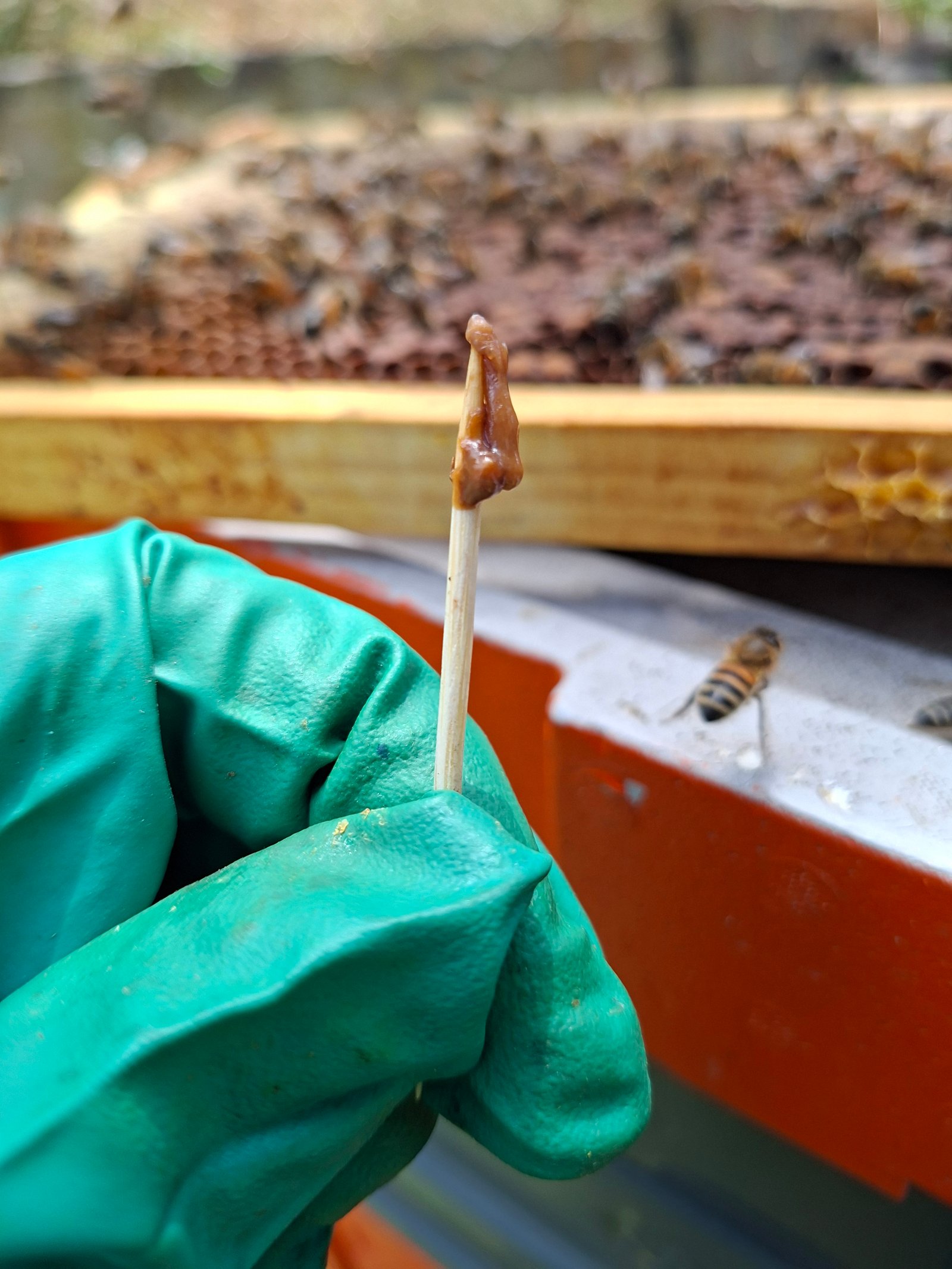
There’s one field test that turns a bad feeling into a firm answer, and every beekeeper should know it. Take a matchstick or a thin skewer, push it into a suspect cell — one of the sunken, discoloured ones — give it a stir, and draw it out slowly.
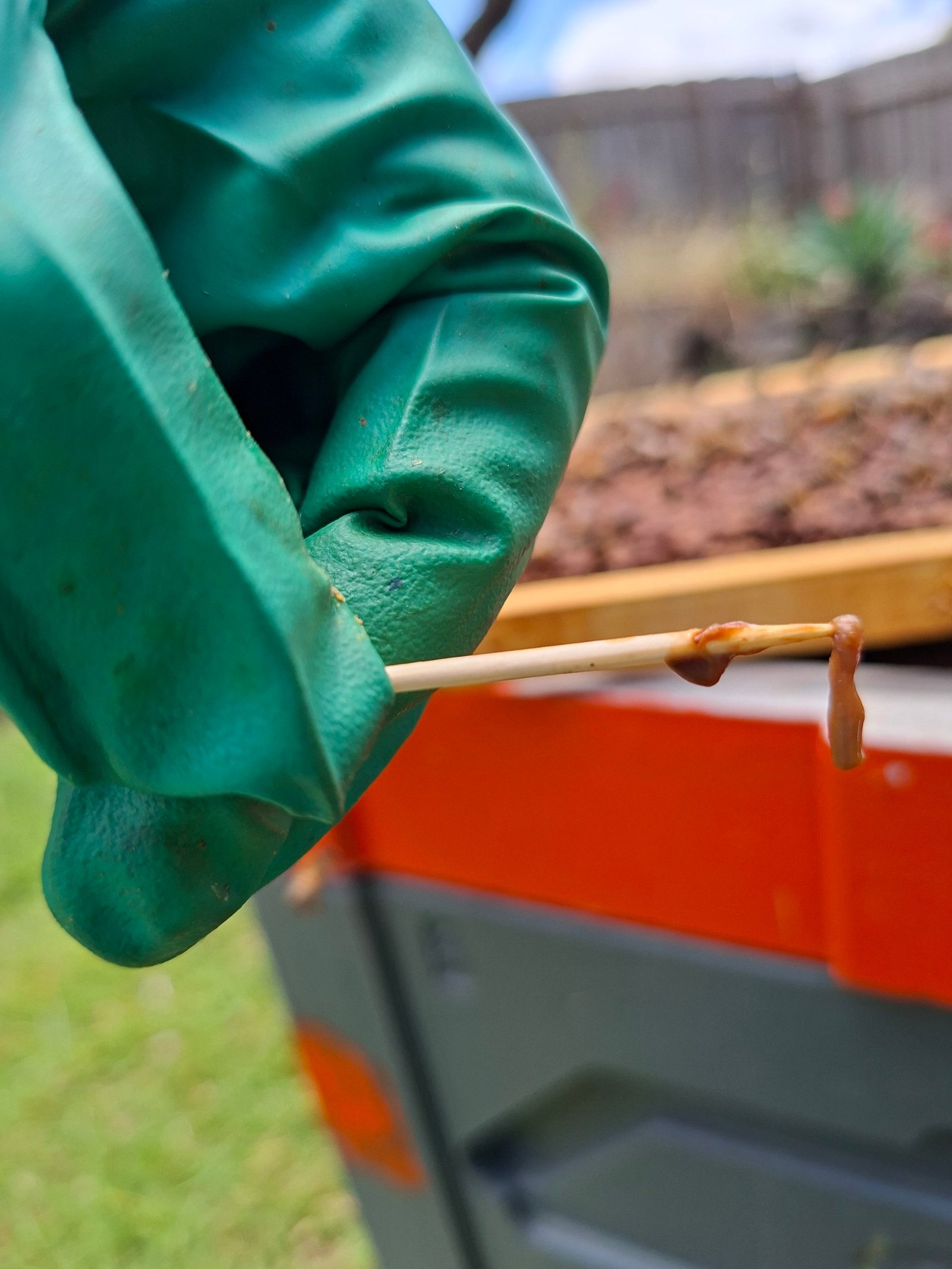
If it’s AFB, the dead larva has broken down into a brown, sticky goo that draws out with the stick into a thread — a rope — that can stretch a centimetre or two or three before it snaps back. That roping is the classic sign of American foulbrood. European foulbrood, the other brood disease it gets confused with, doesn’t rope like this — it stays watery and breaks up.
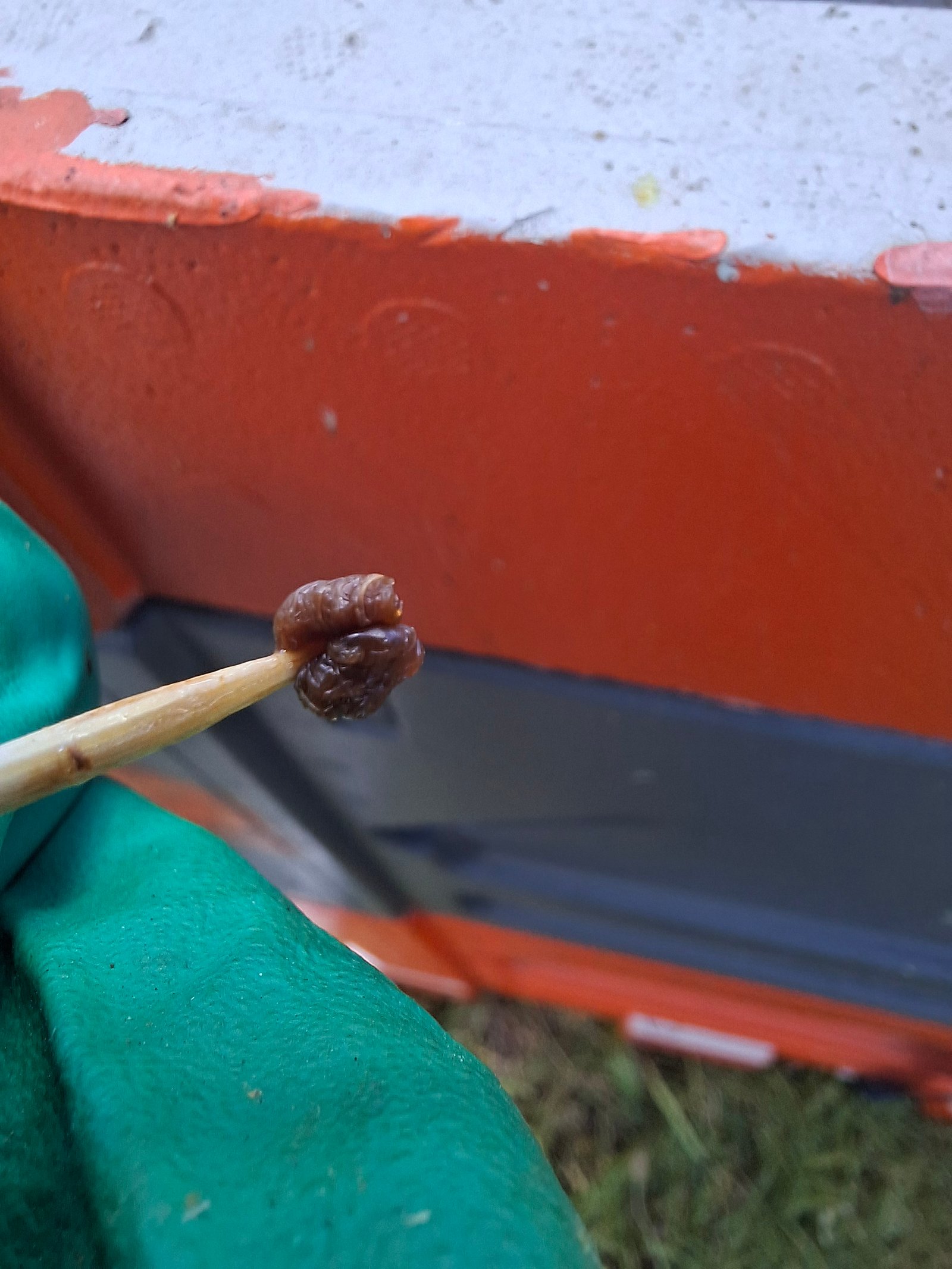
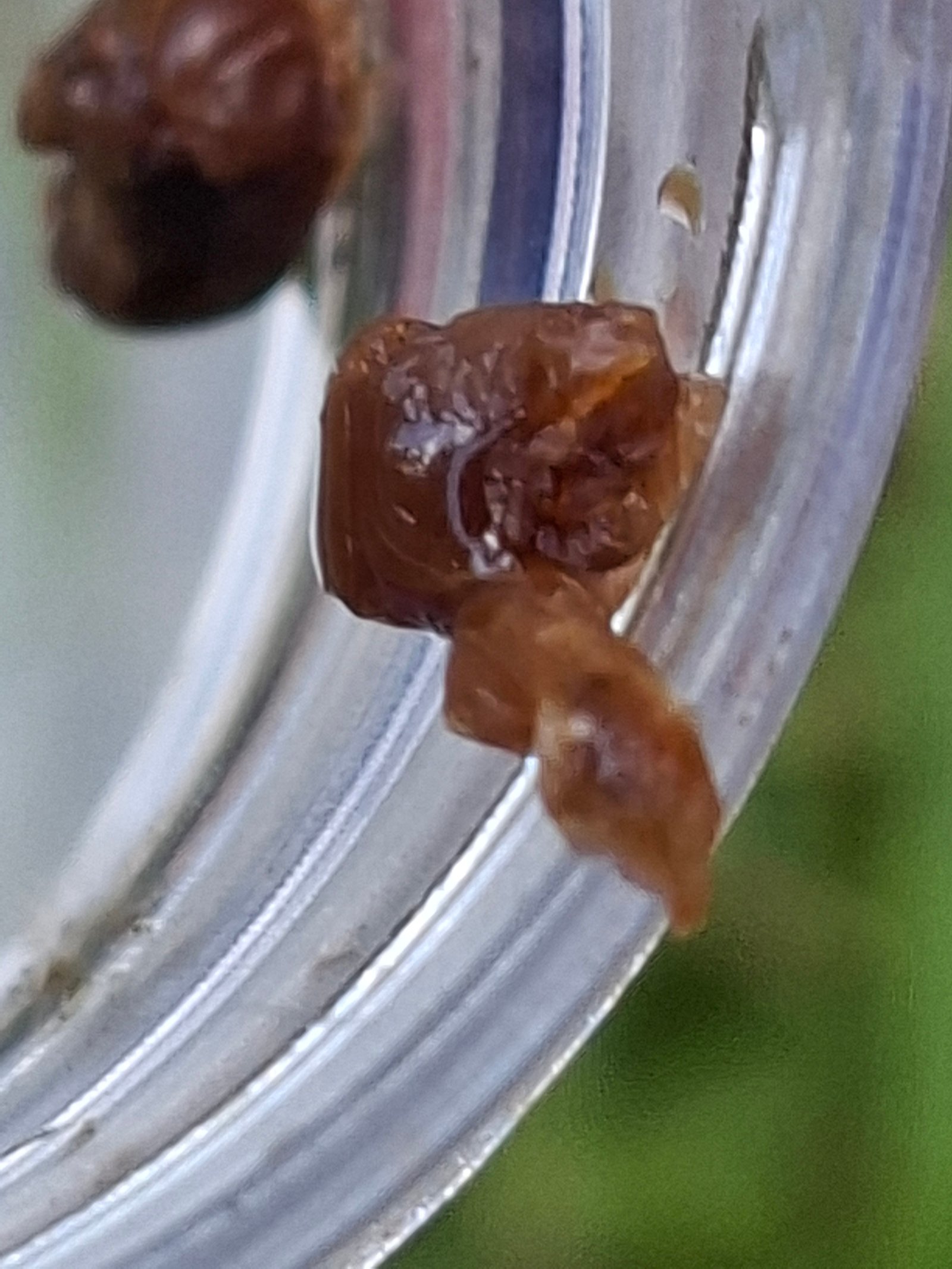
The remains themselves are coffee-brown and glue-like, nothing like the plump, pearly-white larva that should be there. When you see this, you’re not really guessing any more.
I run a second test to back it up: the Holst milk test. Dissolve a suspect scale or the larval remains in a little warm skim milk, and if it’s AFB the bacteria’s enzymes digest the milk proteins — the cloudy milk turns clear within about twenty minutes. It’s a cheap, simple confirmation you can do off a single scale at the kitchen bench.
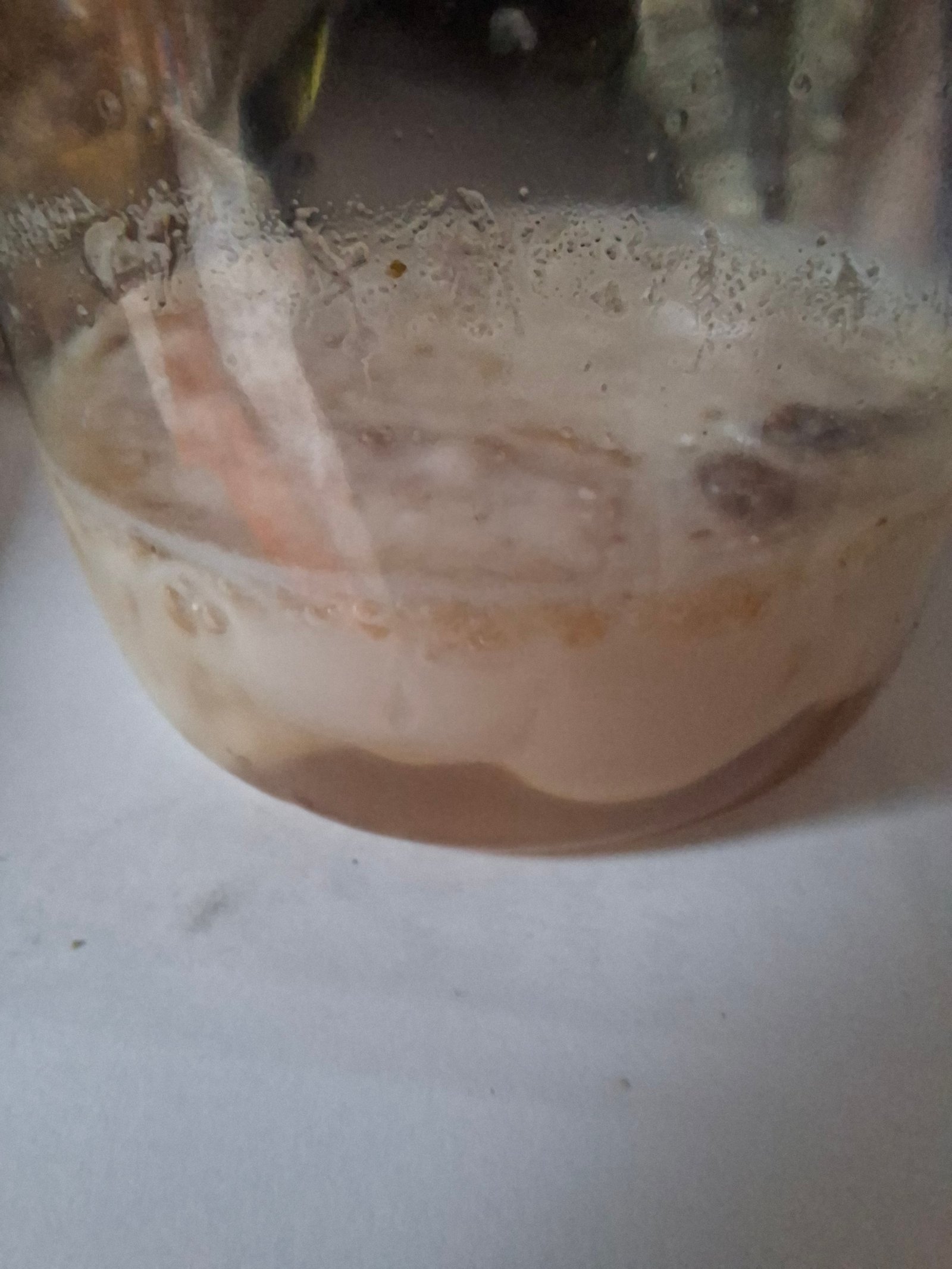
Neither test is the final legal word — an apiary officer or a lab test confirms it — but between them they’re more than enough to act on. And acting means one thing first.
It’s notifiable — report it, don’t treat it
American foulbrood is a notifiable disease. In Victoria that’s not a suggestion, it’s the law — under the Livestock Disease Control Act, the moment you find it or even suspect it, you must report it to Agriculture Victoria’s apiary officers. This isn’t box-ticking. AFB is exactly the kind of disease that gets away when people stay quiet: a weak, infected hive gets robbed by its neighbours, and the spores ride home in the robbers’ honey stomachs to the next apiary down the road.
So there’s no quiet clean-up and no home remedy. There is no treatment — antibiotics don’t cure AFB, they only mask it while the spores keep building, and they aren’t the answer here. Reporting it and destroying the colony is the whole path. Beekeepers have been prosecuted for hiding it and letting it spread; and beyond the law, hiding it lets down every other beekeeper whose bees fly the same few kilometres as yours.
What has to happen — fire and irradiation
Because the spores survive almost anything, dealing with AFB means destroying what holds them. Here’s what I did with this hive.
Seal it first. The instant I was sure, I closed the hive up so nothing could rob it out and carry the spores off. A leaking AFB hive is a disease bomb for the whole neighbourhood, so it has to be shut before anything else.
Put the bees down humanely. The colony can’t be saved or moved — the bees carry spores on them and in them. So rather than burn a living hive, I euthanise the bees first with CO2, which quietly sends them to sleep. It’s the one kindness left in a bad situation, and it matters to me that it’s done properly.
Burn everything that’s left. Once the bees are gone, the comb, frames and the bees themselves all go on the fire — there’s no saving them, because the spores are through the wax and the dead brood. The standard way is to burn the lot in a pit and bury the ash. But this was during a total fire ban, so an open fire was off the table. I sealed everything into heavy plastic and had it incinerated at a crematorium instead: same outcome, done legally, nothing left but ash.
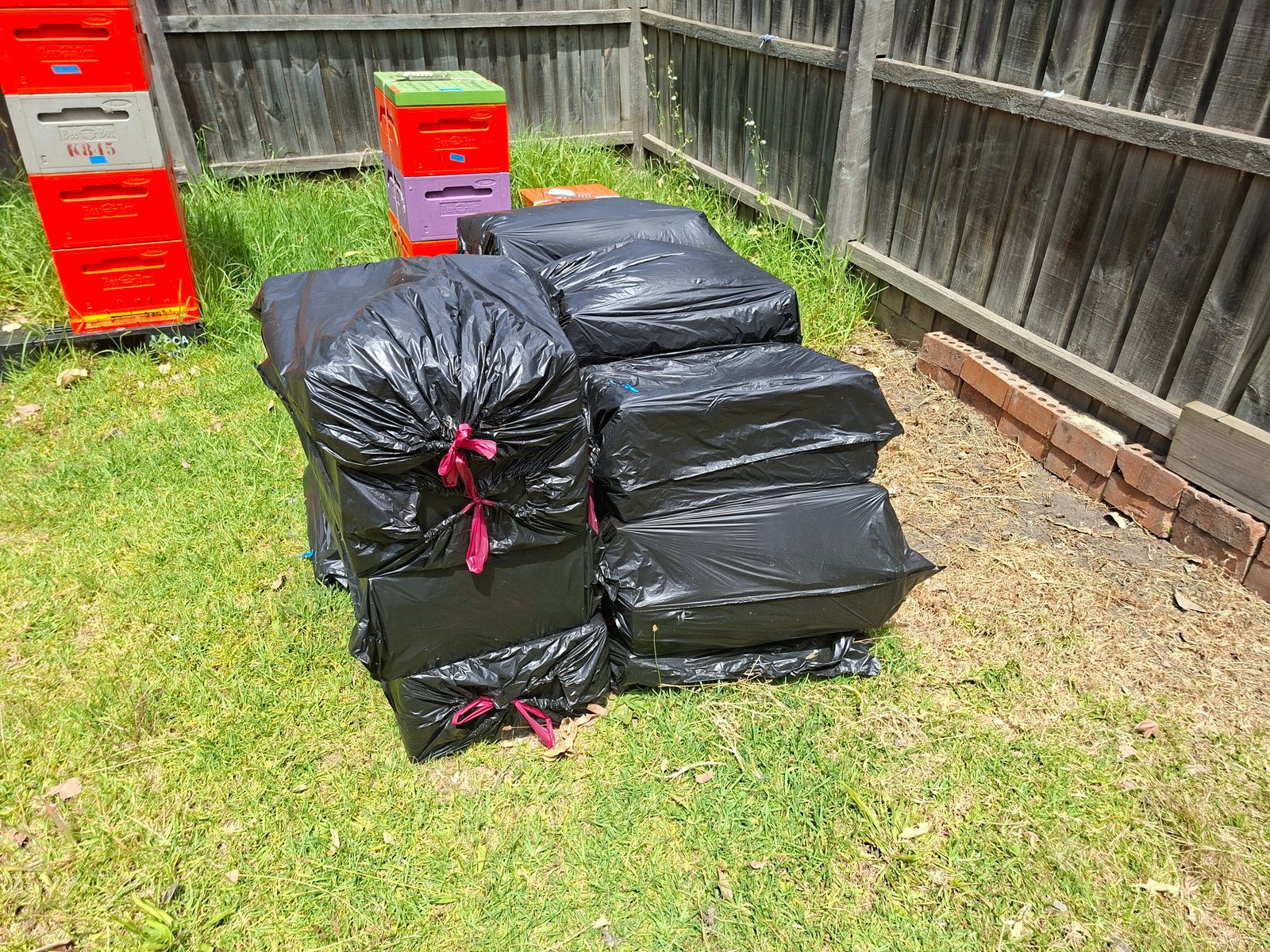
Sterilise the boxes. The boxes, lids and bases are worth saving — but only if the spores are killed, and you can’t just scrub them clean. Mine are poly, so I sent them to Steritech to be gamma-irradiated, which sterilises the spores and lets the boxes go straight back into service. Irradiation is the reliable way to save gear; bare timber can also be scorched or paraffin-dipped, but poly won’t take that, and bleach or a hot wash isn’t anywhere near enough on its own.
Keeping it out of your hives
AFB is far easier to keep out than to clean up. What I do, and what I teach:
- Inspect the brood, regularly. You can only catch it early if you actually pull brood frames and look, right through the season.
- Don’t shuffle frames between hives. Swapping brood or honey frames hive-to-hive is the fastest way to move a disease you can’t yet see.
- Sterilise the hive tool between hives. A scrape and a flame, or a wipe, so you’re not carrying spores on your steel from one colony to the next.
- Never feed honey of unknown origin. Shop honey and other people’s honey can carry AFB spores; only ever feed your bees their own.
- Register, and test. In Victoria every beekeeper must register their hives, and anyone with 50 or more must do an annual honey culture test that screens for AFB spores — cheap insurance, and worth doing even if you’re small.
This is “barrier management” — the same principle behind everything on our raw honey standard: keep each hive’s world clean, and don’t move problems around on your hands and gear.
The one time I destroy a hive without hesitation
Everything about BeesFriend is no-kill. I relocate colonies alive, I rescue swarms, I don’t gas bees or torch hives for convenience. American foulbrood is the one exception — and it isn’t really an exception at all, it’s the same principle. A hive with AFB can’t be saved, and every day it stays alive it puts every other colony for kilometres around at risk. Burning it isn’t giving up on bees; it’s protecting all the other bees.
That’s why, the moment a rope test comes up positive, the hive is gone — reported, sealed, the bees put down humanely, and on its way to the fire — with no second-guessing. It’s the hardest job in beekeeping and the clearest. If you keep bees, learn the signs, keep looking at your brood, and know what you’ll do if you ever draw out that brown thread. If you want to learn to read a hive this way — the good and the bad — that’s exactly what I teach through beekeeping mentoring.
Frequently asked questions
What is American foulbrood?
American foulbrood (AFB) is a highly contagious, incurable bacterial disease of honey bee brood, caused by Paenibacillus larvae. It kills larvae after the cell is capped and forms tough spores that survive for decades in comb, honey and equipment. It’s endemic in Australia and notifiable — it must be reported.
What does AFB look like?
A patchy, “pepperpot” brood pattern; cappings that are dark, greasy, sunken and often perforated; dead larvae that turn from white to coffee-brown and slump down the cell; and sometimes a foul, glue-pot smell. Over time the remains dry into a hard “scale” stuck to the lower cell wall.
What is the ropiness test?
Push a matchstick into a suspect cell, stir, and draw it out slowly. If the dead larva strings out into a brown, mucus-like thread a centimetre or more long, that “roping” is the classic sign of AFB. It’s a strong field indicator, but confirmation is by an apiary officer or a laboratory test.
AFB or European foulbrood — what’s the difference?
European foulbrood (EFB) tends to kill younger, unsealed larvae, which twist and discolour in open cells and don’t draw out into a rope. AFB kills after capping and ropes. If you’re not sure which you’re looking at, test, and report a suspicion of AFB rather than sitting on it.
Can American foulbrood be treated or cured?
No. There is no cure and no legal, effective treatment for AFB in Australia. Antibiotics only mask it while the spores keep building. The only path is to report it and destroy the colony, then destroy or sterilise the equipment.
Do I have to report AFB?
Yes. AFB is a notifiable disease. In Victoria you must report it to Agriculture Victoria’s apiary officers as soon as you find or suspect it — reporting is a legal obligation, and it’s how the disease is stopped from spreading between apiaries.
How do you get rid of AFB?
Seal the hive so it can’t be robbed and report it, then humanely euthanise the bees (I use CO2). The dead bees, comb and frames are then destroyed by fire — burnt in a pit and buried, or incinerated where open fire isn’t allowed. The boxes can be saved only if the spores are killed: gamma irradiation (such as Steritech in Victoria) does it for any box, and bare timber can also be scorched or paraffin-dipped.
Do the bees have to be destroyed too?
Yes. The bees carry spores on and in them, so the colony can’t be saved or moved onto clean gear. They should be euthanised humanely first — I use CO2 — rather than burnt alive, and then destroyed along with the comb.
Is AFB dangerous to people?
No. American foulbrood is a disease of bee brood. It doesn’t infect people or animals, and it doesn’t make honey unsafe to eat. The danger is entirely to bees — but to bees it’s one of the most serious diseases there is.